I have been putting the final touches on Avadon: The Black Fortress for Windows in the hope of releasing it next week. I have also been shepherding the game through beta-testing on the iPad. The rest of my time has been spent trying to convince myself that I'm not having a heart attack. Also, wishing they made office desks with hutches with space in the middle for a large iMac.
(Boy. It would be funny if I really did have a heart attack now. People would link to this blog post and go, "Wow! Irony!" in the same way everyone gets totally tickled to find the Facebook page of a recent mass-murderer. And remember, if I do die, and you pirate Avadon, I will then be able to totally haunt you and I'll be floating by the ceiling when you use the bathroom, making spooky noises.)
(I'm just sayin'.)
In the meantime, if you want to satisfy your cravings for hearing me discuss finer points of computer design in my weird voice, you should go here. It's a Podcast Interview for The Veteran Gamers, and it turned out OK. It should be worth your time, as I talk very quickly.
Finally, as I write this, the Playstation Network has been down for eight days. What's up with that? Networks go down. That's what they do. But eight days? Wow. Can you imagine the apocalypse of sleep-deprived horror going on at Sony now? Something crazy much be wrong.
Normally I wouldn't care, because most of my gaming is single-player, but my PS3 is my Netflix device. I can't watch Netflix on my XBox because the fans in that thing sound like a jet engine powering up. And Netflix on the Playstation requires PSN to work. Because everything about PSN has always been designed from a place of deep hate.
Thursday, April 28, 2011

Thursday, April 14, 2011
Dragon Age II Review: Get a Grip, Folks!

Since I raved so enthusiastically in this space about Dragon Age: Origins (and Bioware games in general), I suppose I really should say something about Dragon Age II as well. This one is a bit trickier.
It's impossible to discuss Dragon Age II without a bit of criticism, which makes me sad. A lot of skilled people worked really hard over an overly-short period of time to make this game, and I strongly suspect that most of its problems were out of their control, due to directives from above. As somone who writes games myself, I truly sympathize. The inevitable result has been a game that's caused quite a bit of controversy over its quality.
The best place to see this confusion is over on Metacritic. As of this writing, reviewers have given the game an entirely respectable score of 82 (out of 100). Players, on the other hand, have given Dragon Age II a dismal 4.3 out of 10. That is a huge gap!
But it makes a lot of sense. Reviewers have to review the actual game as it exists, not their fantasies about what it might be. Dragon Age II is a flawed but basically competent and enjoyable action-RPG. 82 out of 100 is a B-, and Dragon Age II is a pretty solid B- of a game.
In fact, suppose it didn't have Dragon Age in the title at all. Suppose it was called, say, "Bioware Presents: A Dude Named Hawke Buys a Big House and Has Wacky Adventures." Suppose further that EA had given Bioware the bit of extra time and budget necessary to fix the game's most notable flaws. (Dungeon layouts reused to an egregious extent. A bizarre combat system where reinforcements pop in from out of nowhere. Extreme bugginess, especially in the late game.) If this was the case, I honestly believe the result would be considered a lesser but worthy member of the Bioware canon, something pleasing to pass the time while waiting for Dragon Age II.
But that's not what happened. Dragon Age II is ... well, it has "Dragon Age" in the name. It's the sequel to one of the best-written, epic, envelope-pushing RPGs pretty much ever. I game I truly loved. (If you haven't played it, why are you wasting your time reading this junk? Go get it! Go!) And there's no suger-coating the basic fact of the thing. If you got Dragon Age II expecting something more like Dragon Age: Origins, you are going to face a period of harsh disappointment.
But I'm going to have to defend Dragon Age II here for a bit. There's a lot of really good stuff here, and some of the design choices are really interesting. Other people have dumped on this game enough. Let's take a moment to look at the nice things.
Great Writing
Nobody puts great writing in games like Bioware. Dragon Age II didn't contain as much of that Dragon Age Magic (tm) as I might have hoped for, but it was a beautifully written game. The characters didn't grab me instantly in the way they did in the previous game, but they really grew on me, especially Varric. When my companions talked to each other, I always stopped whatever I was doing to listen.
Considering how crappy most video game writing is, I really think we shouldn't take Bioware for granted!
Also, this game had the most insane, over the top, out of nowhere plot development I've ever seen in an RPG. (Which part? One word ... Mom.) Dang it, it deserves props for that!
Cool Character Development
I loved the skill trees. The mix of abilities, constant effects, and passive bonuses, combined with being able to decide between getting new abilities and making old ones better, made training very interesting. I retrained my characters several times and found that it was possible to customize my characters for a number of different play styles, which is always good.
The combat did involve a lot of button mashing, but the abilities were varied and dramatic enough that I was rarely bored.
Some Really Good Ideas For Combat
Battles in Dragon Age II are almost always against waves of foes, generally starting easy and getting harder. You need to conserve your powers, using them when they are most needed.
The way the game throws reinforcements into the battlefield deserves some mockery. They are scattered in at random, sometimes literally dropping from the sky before your eyes. If they had entered the fray in a less immersion-breaking way (say, running from deeper in the dungeon), it would have worked better. However, this basic idea of how to structure combat shows a lot of potential, and I hope other games explore it. (Which is my way of saying: I really should steal that idea.)
The Theme Still Works
His writing is as impenetrable as ever, but Tycho over at Penny Arcade does a great job of breaking down what Dragon Age is really about and how cool it is. These games aren't about fighting Big Fantasy Nasties. Sure, they have fights and monsters, but that is not what they are Capital-A About. They are about politics and power structures and compromises and how actions and decisions can shift history. It's a very cool and ambitious territory to explore, and Bioware has close to a monopoly on it.
Dragon Age II doesn't operate on the same scale as the previous game in any way, and yet it covers much the same ground. It focuses on one city instead of a whole nation and a handful of political squabbles instead of one great crisis, but their hearts are in the same place. And, frankly, this design concept deserves a lot more exploration.
In Closing
Dragon Age II is a flawed product that is still more interesting than a more polished mediocrity. Starting it is a very jarring experience for anyone with fresh memories of the first classic, but, if you walk away, take a breath, and resolve to meet it partially on its own terms, it's worth the sixty bucks.
A lot of people hate it, but hey, the Internet exists to help people hate things in a purer, more intense fashion. And, hey, if you hate Dragon Age II, that's your right.
But I think it's important for fans to not price themselves out of the market here. Bioware is still making good role-playing games, a genre that has been painfully neglected in the past. It's fun to indulge in a nice hate-frenzy from time to time, but let's try to keep on talking terms with reality here. They're still one of The Good Ones.
Wednesday, April 6, 2011
"Whom" Is Dumb.
This will be one of those blog posts where I go and court controversy. No, it won't be about software piracy. Something worse. I'm going to tempt the anger of grammar people.
I make my living as a writer. Sure, game design and programming are part of it, but the main selling point of my games has always been the stories. Each game I write has over one hundred thousand words, enough for a decently sized novel. That means that many young, impressionable minds have spent hours and hours reading my writing, being infected by my questionable grammar and unwholesome penchant for. Sentence fragments.
Thus, when I take the side of the Visigoths who want to simplify the rules of our language, I get to have a actual (if small) influence on how my young readers write, simply by being a bad example. It is a grim responsibility, and, at times, I must take a stand. I must use my awesome Role Model power to Make a Difference. Therefore, I must make this proclamation.
I will never use the word "whom" again. It's stupid.
Turning My Ignorance Into a Sacred Principle
Actually, I still have no idea exactly when to write whom and whomever and whomungous. I must have had bronchitis the day they covered that in school. (The same day they explained how to tell what syllable is accented and how relativity works.) So, for the sixteen years I've spent writing my million words and counting, I've never used "whom" properly unless prompted by proofreading beta testers. The rest of the time, I used "who" and "whoever."
And you know something? Hasn't done a bit of harm. Hasn't harmed comprehensibility at all. Hasn't earned me a single complaint from a customer in sixteen years. And, believe me, I get complaints about everything.
Don't get me wrong. Grammar has its place, and its rules should be obeyed. First, however, it is fair to evaluate those rules and see if they carry their freight. Does the effort to have the rule justify itself with better communication?
In this case, no. Everything "whom" does can be done with "who." This inefficiency offends my soul.
Also, using "whom" makes one sound really, really affected and twitlike. Which is not usually my goal. (Only sometimes.)
So I'm done with it.
But I Believe In Compromise.
I have to admit that the word "whom" sounds pretty nice. It's an elegant, cultured sounding word, the sort of word that might be used by Jane Austen or an Ent. I can see that some might be saddened by its loss.
Therefore, I propose this compromise: You can use the word "whom" when it would be correct, under the old, dead rules. In addition, you can use "whom" whenever you would say "who," or whenever it would sound good, or at any other point.
For example, by this new, simple, elegant rule, the following sentences are considered to be correct:
Ahhhh. That Felt Kind Of Good.
I hope that all whom are reading this join me in my crusade against "whom." Being a Visigoth is really lots of fun. Give in.
And I wish upon all of you whom the same blessing I have been given: That, when you want to spend some time tearing down instead of building up, you also have access to at least a few young, impressionable minds. It's awesome. Whom.
I make my living as a writer. Sure, game design and programming are part of it, but the main selling point of my games has always been the stories. Each game I write has over one hundred thousand words, enough for a decently sized novel. That means that many young, impressionable minds have spent hours and hours reading my writing, being infected by my questionable grammar and unwholesome penchant for. Sentence fragments.
Thus, when I take the side of the Visigoths who want to simplify the rules of our language, I get to have a actual (if small) influence on how my young readers write, simply by being a bad example. It is a grim responsibility, and, at times, I must take a stand. I must use my awesome Role Model power to Make a Difference. Therefore, I must make this proclamation.
I will never use the word "whom" again. It's stupid.
Turning My Ignorance Into a Sacred Principle
Actually, I still have no idea exactly when to write whom and whomever and whomungous. I must have had bronchitis the day they covered that in school. (The same day they explained how to tell what syllable is accented and how relativity works.) So, for the sixteen years I've spent writing my million words and counting, I've never used "whom" properly unless prompted by proofreading beta testers. The rest of the time, I used "who" and "whoever."
And you know something? Hasn't done a bit of harm. Hasn't harmed comprehensibility at all. Hasn't earned me a single complaint from a customer in sixteen years. And, believe me, I get complaints about everything.
Don't get me wrong. Grammar has its place, and its rules should be obeyed. First, however, it is fair to evaluate those rules and see if they carry their freight. Does the effort to have the rule justify itself with better communication?
In this case, no. Everything "whom" does can be done with "who." This inefficiency offends my soul.
Also, using "whom" makes one sound really, really affected and twitlike. Which is not usually my goal. (Only sometimes.)
So I'm done with it.
But I Believe In Compromise.
I have to admit that the word "whom" sounds pretty nice. It's an elegant, cultured sounding word, the sort of word that might be used by Jane Austen or an Ent. I can see that some might be saddened by its loss.
Therefore, I propose this compromise: You can use the word "whom" when it would be correct, under the old, dead rules. In addition, you can use "whom" whenever you would say "who," or whenever it would sound good, or at any other point.
For example, by this new, simple, elegant rule, the following sentences are considered to be correct:
"Whom just fell into the wheat thresher?"
"You must be the hobbits whom are from the Shire?"
"Whom whom whom hello there whom whom whom whom whom."
"You must be the hobbits whom are from the Shire?"
"Whom whom whom hello there whom whom whom whom whom."
Ahhhh. That Felt Kind Of Good.
I hope that all whom are reading this join me in my crusade against "whom." Being a Visigoth is really lots of fun. Give in.
And I wish upon all of you whom the same blessing I have been given: That, when you want to spend some time tearing down instead of building up, you also have access to at least a few young, impressionable minds. It's awesome. Whom.
Tuesday, March 29, 2011
Review: Minecraft

Since I like to write about Indie game design, it is inevitable that, at some point, I must discuss Minecraft. Written by this Swedish guy commonly known as Notch, it emerged overnight to take over the world and sell meeelions of copies. It has had a level of success my games can never ever hope to match, and it's kind of earned it.
Of course, I could go on, as many others have, about the soul-crushing lack of anything in the game to help anyone actually understand it. Of course, officially, it's still a beta, but it's still super harsh in the early going. Don't try to play it without reading this Newbie FAQ and bookmarking the recipe list, unless you enjoy suffering.
For the few people who haven't played it yet, Minecraft is usually described as a Lego video game. You start out a guy on a deserted island. You can gather cubes of dirt and wood and stone and use them to build, well, whatever you want. Houses. Castles. Roller coasters. There's no plot, per se. It's a creativity tool and an incredibly addictive one. The game system is very simple, allowing for hilarious mishaps, outlandish creations, and manifestations of mental illness.
I made a nice two bedroom house for a family of four. There's a wall around it. It's nice.
But for a no-budget Indie game to sell north of 1.5 million copies? In beta? There is something crazy insane going on here, some sort of true genius. This guy captured lightning in a bottle, with a fairly crude-looking game with no tutorial and a punishingly difficult first ten minutes. I honestly wouldn't have thought it possible. Anyone who cares about game design should look closer and see what this guy did right...
You Have To Earn What You Get
If you want to make a house out of 500 blocks of stone, you first have to dig them up. But then you just have an empty house. If you want something nice, like a clock or a golden pillar or a roller coaster, you have to search more and dig deeper. One of the key elements of Minecraft is the personal satisfaction you get from looking at what you built, which comes in part from knowing that you had to spend your time to earn it. And people do spend the time, because ...
You Get Stuff Fairly Quickly
The guiding principle behind Minecraft seems to be that you have to earn everything you get (by spending time), but practically everything comes cheaply. The stone to make a fortress can be dug up fairly quickly. The key insight here is that, to give a player self-satisfaction, you do need to charge a price (again, paid in your time), but that price can be very small. As long as there is any price at all, even a low one, the player can feel pride in his or her creation.
There Is Danger
On normal difficulty or higher, monsters can spawn anywhere where it is dark. And these aren't candyass, meaningless trash monsters, either. They are skeleton archers that can kill you dead before you even figure out where they are and exploding ambulatory suicide cacti that spend one second hissing in warning before they pop, killing you and destroying everything nearby.
Minecraft was never meant to be a shooter. You can make weapons and armor, but they're tough to make and wear out quickly. The vast majority of foes should simply be avoided. The point of the game is not kicking ass but achieving safety.
Now, to be clear, the danger element is not necessary. Plenty of players switch the game to Peaceful difficulty and never face a worse threat than falling into lava. But for players like me, who need some sort of story element or immediate goal to get into a game, the pressing need to make a Safe Place is a perfect way to feel involved. And, once the game gets you actually playing, it becomes much easier to answer the most difficulty question any creativity toy poses: "I can make anything I want, but what do I want to make?"
But Not Too Much
Minecraft is dangerous, but not too dangerous. Torches are easy to make, they never go out (for now, see below), and monsters never spawn in lit areas. It is easy to make an enclosed place where monsters will never jump you. And yet, if you ever walk outside or if you accidentally leave a dark spot in your house, the danger comes pouring back in.
And, much in the same way that only a tiny amount of effort gives a player pride of ownership, the mere awareness of danger is enough to keep things interesting. Once, when I was modifying my house, I forgot to place a torch in one of the rooms. It gets dark, I go to bed, a zombie spawns in that room, and, when I wake up, it's eating my face.
No matter how safe you make things, a moment of complacency can always kill you. The constant presence of danger can make anything more interesting, even stacking little cubes.
The Game Model Is Incredibly Forgiving
Game designers frequently want to make things too hard for players. There is a constant fear that someone, somewhere, is getting away with something. For example, it must have been very tempting to have Minecraft have a real physics model. Make your wood building too big or unbalanced, and watch as it crumbles before your eyes. Hah! Take that, you dumb gamer!
Minecraft isn't like that. It's a creativity tool. It strongly resists the desire to be hardass about what you can build and gets out of the way as much as possible. Want your giant stone castle to hang in midair? Sure! The game's job is simply to let you create.
With one limitation. Fire is merciless. Try to burn up the patches of brush in front of hour house and I promise, within five minutes, your happy green island will look like Mordor.
And the Developer Is Very Generous
For the amount of entertainment the game can provide, it's amazingly cheap. Around twenty bucks for the beta, and that comes with all future patches. No DRM. No recurring fees. One account serves as many machines as you want to use it on. And once, when their ordering servers were down, Notch simply made the game free.
This is just one example of someone becoming very successful by making something really cheap. See also: Humble Indie Bundle.
But We're Just At the Beginning
One of my favorite things about Minecraft is that it's a work in progress. We can watch the developer's tightrope act in real time, and they might still screw everything up!
For example, they have been flirting for a while with making torches go out. You would have to spend time running around with flint and steel relighting torches, or areas will go dark and "Oh God! Zombies! My face! Aaaahhhh!" This would be a huge change in the nature of the game, introducing a new activity that would pull lots of time away from the core activity: gathering materials and doing stuff with them. This change has been put off for a while, though, so they may have had the wisdom to rethink it.
(In fact, watch for any change that will heavily alter the proportion of time the player spends on various activities - digging, building, etc. These are the changes that will muck up the game.)
They are also considering adding Hardcore mode, where if you die your world is gone for good. I suppose this is a good change, since it is optional and some people love pain.
But I suspect that their design instincts are pretty good. Instead of making torches go out, they are adding cute wolf pets. Genius. My daughters will die of happiness.
So Try It
If you love Indie games, try this one. It takes some work to get into it, but it is a worthwhile exercise just too see how much innovation small developers are capable of. I am on the record as saying that small Indies aren't as innovative as people give them credit for. This is one case when I've been very happy to be proved wrong.
Tuesday, March 22, 2011
Minecraft Makes Little Girls Cry.


I've been playing Minecraft a lot lately (when I'm not porting our newest game to Windows and iPad), and I will have several things to write about this truly fascinating game. For example, my nine year old daughter is addicted to it, and I thought her first experience with it was telling.
Here is a brief summary of my daughter's initial Minecraft session:
Starts game at spawn point.
Walks a long way from spawn point.
Builds most of a house.
Tries to make the roof of the house by placing a block of sand directly above her.
The block of sand falls onto her.
She suffocates.
She respawns at the start point.
She can't figure out where her house is.
She cries.
Walks a long way from spawn point.
Builds most of a house.
Tries to make the roof of the house by placing a block of sand directly above her.
The block of sand falls onto her.
She suffocates.
She respawns at the start point.
She can't figure out where her house is.
She cries.
So what have we learned? First, that Minecraft is truly an educational game, punishing lack of foresight with an almost Eve-like intensity. It has much to teach about planning and forethought, and it delivers its lessons in the most painful way possible. Nothing educational can have value without the possibility of crushing failure.
Second, this would be a great bit of ad copy:
Minecraft - It makes little girls cry.
Third, after she went to bed, I logged in and spent a minute finding her house again. This made me a hero with a ludicrously small amount of effort. That justifies the twenty bucks spent on the game right there.
More to follow, once I figure out how to make a cake.
Friday, March 11, 2011
My Very Brief Review of Halo: Reach.

Every game should have jetpacks.
(Actually, maybe a little explanation. My wife and I play every Halo and Gears of War game together in co-op. It's happy-close-couple-relationship-time.)
(Sadly, the single-player components of Halo games have gotten painfully phoned in. The kick-ass set pieces of Halo 3 have degenerated into long, tedious sequences of interchangeable roads and warehouses.)
(But Halo: Reach has JETPACKS. And that is AWESOME. For the three minutes it lets you play with them.)
(Every mission in Halo: Reach should give you jetpacks. You should be able to boing-boing-boing all over the dang place.)
(Actually, what's more, every game should have jetpacks. Dragon Age. Minecraft. Farmville. Rock Band. EVERY game.)
(Tetris should have jetpacks.)
(Jetpacks.)
Thursday, March 10, 2011
The Whittling Part Of the Brain
(One of the reasons I started this blog, besides pimping my games, was to resurrect some of my old writing that has disappeared from the face of the Earth. For example, about a decade ago, I wrote a column for the late, lamented Computer Games Magazine called The Grumpy Gamer. Here it is, only slightly updated.)
(This was the first column in that series, and, while its basic idea is simple, I still think this piece or writing is True. What still fascinates me is the way some people feel that their way of resting their brain makes them oh so superior to people who rest their brains in a different way.)

The Whittling Part Of the Brain
I have spent the last several years of my life designing computer role-playing games for a living. Thus it came to be that after a friend of mine, who designs board games for a living, couldn’t figure out why anyone found Everquest to be the slightest bit fun, he came to me for an explanation.
For those of you who haven’t experienced this particular brand of delight, most of the Everquest experience tends to involve waiting next to a place where wimpy monsters appear, waiting for them to appear, butchering them once they do appear, collecting their loot, and repeating this process until it’s five in the morning. For the uninitiated, this looks, let us be frank here, like a big waste of time.
But, when he asked me why anyone would want to do this, I had an explanation ready. It’s the same explanation I give whenever anyone asks me what the point of playing computer games is. I simply say that computer games satisfy the Whittling Part of the Brain.
Some of you, in this advanced, techmological age, may not be familiar with the concept of whittling. To whittle, you sit down with a knife in one hand and a stick (or other piece of wood) in the other. Then you take the knife and systematically proceed to carve thin slivers of wood off the stick until there’s nothing left but a pile of wood shavings and your own sense of deep self-satisfaction.
(This sounds, of course, like a pretty dubious source of entertainment, but people do some pretty bizarre things to kill time. Like watch Jersey Shore, for example.)
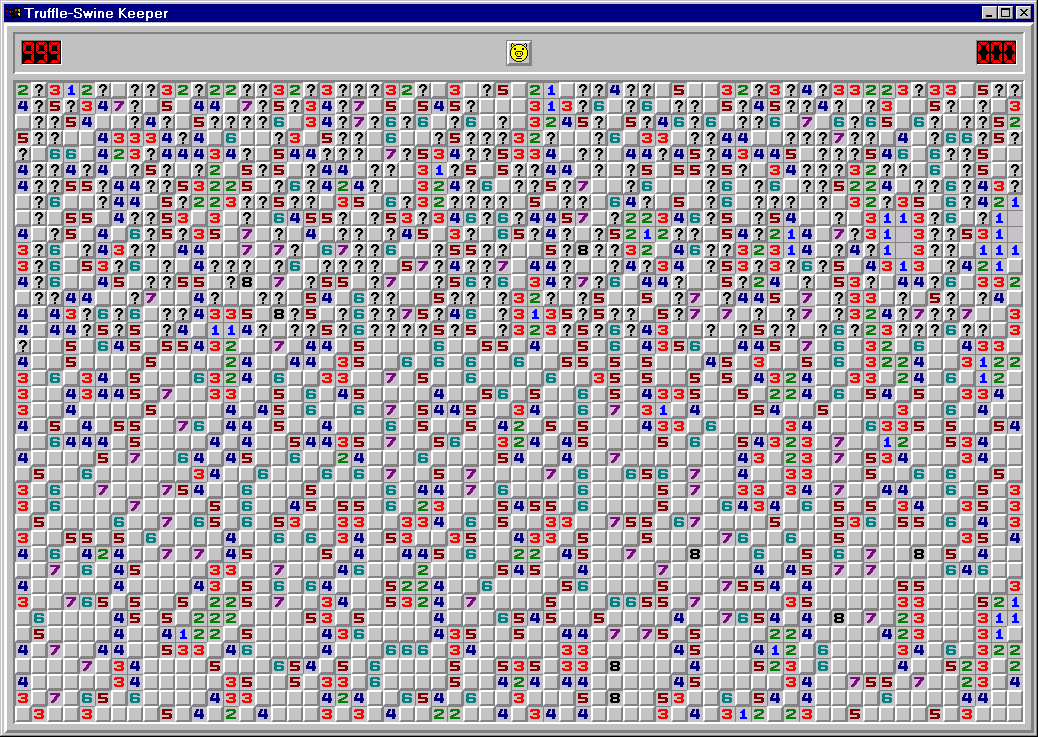
Of course, this sort of thing is what people did before computers were invented. Or televisions. Or fun. Nowadays, people can do all sorts of low-thought things to pass the time. Knitting and needlepoint. Crossword puzzles. TV. Reading mystery novels. Playing Minesweeper. And playing computer role-playing games.
The human brain just seems to have a need for resting, for passing some time in a low-energy state. Computer role-playing games are perfect for that. When I fight fifty basically identical combats against darkspawn in Dragon Age or spend five hours finally getting my level 13 druid in World of Warcraft to level 14 or piled a hundred bricks on top of other bricks in Minecraft, I’ve done more than waste my time. I’ve given by brain rest that, for reasons I can’t begin to understand, it craved.
And, of course, some of my friends think that I’m wasting my time, both designing the games and playing them. The same friends who don’t think twice about doing their five thousandth crossword puzzle, or reading basically the same damn mystery novel for the billionth time. Or read The Onion, like that’s such an enriching activity. People just like to fritter time away, and computers give us an unusually satisfying way to do it.
The most important thing about these low-brain activities is that they have to be rewarding in some way. They have to give us occasional positive feedback, little flashes of satisfaction. Sometimes, when whittling, you might carve away a particularly long and attractive spiral of wood. (Yeah. I know. Just bear with me on that one.) When knitting, you have the satisfaction of finishing your sweater. With a crossword puzzle, you feel smart when you finish.
And when playing a role-playing game, you get a constant, pleasing form of feedback in the form of gold and experience points. Or upgrading from a +1 to a +2 sword. Or getting a new spell, or completing a quest. Everquest is particularly cunning in the way it rewards the player. It has the character’s skills constantly creep upward, a tiny bit at a time, providing a constant stream of tiny rewards.
Now sure, when described this way, the whole activity sounds a little sad and lame. But really, when you think about it, if it’s such a pointless activity, why do we want to do it? I have found that, in general, our brains our smarter than we are. They want what they want, and if my brain wants to spend a while in front of a computer screen stabbing orcs, who am I to tell it it shouldn’t?
So there you go. In just the first column in this series, I’ve come up with a complete, comprehensive explanation for why it’s good and healthy and productive for us to like to play computer games. And I will recite it to myself, again and again, at two in the morning, when I’m lying awake trying to convince myself that I’m not wasting my life.
(This was the first column in that series, and, while its basic idea is simple, I still think this piece or writing is True. What still fascinates me is the way some people feel that their way of resting their brain makes them oh so superior to people who rest their brains in a different way.)
The Whittling Part Of the Brain
I have spent the last several years of my life designing computer role-playing games for a living. Thus it came to be that after a friend of mine, who designs board games for a living, couldn’t figure out why anyone found Everquest to be the slightest bit fun, he came to me for an explanation.
For those of you who haven’t experienced this particular brand of delight, most of the Everquest experience tends to involve waiting next to a place where wimpy monsters appear, waiting for them to appear, butchering them once they do appear, collecting their loot, and repeating this process until it’s five in the morning. For the uninitiated, this looks, let us be frank here, like a big waste of time.
But, when he asked me why anyone would want to do this, I had an explanation ready. It’s the same explanation I give whenever anyone asks me what the point of playing computer games is. I simply say that computer games satisfy the Whittling Part of the Brain.
Some of you, in this advanced, techmological age, may not be familiar with the concept of whittling. To whittle, you sit down with a knife in one hand and a stick (or other piece of wood) in the other. Then you take the knife and systematically proceed to carve thin slivers of wood off the stick until there’s nothing left but a pile of wood shavings and your own sense of deep self-satisfaction.
(This sounds, of course, like a pretty dubious source of entertainment, but people do some pretty bizarre things to kill time. Like watch Jersey Shore, for example.)
Of course, this sort of thing is what people did before computers were invented. Or televisions. Or fun. Nowadays, people can do all sorts of low-thought things to pass the time. Knitting and needlepoint. Crossword puzzles. TV. Reading mystery novels. Playing Minesweeper. And playing computer role-playing games.
The human brain just seems to have a need for resting, for passing some time in a low-energy state. Computer role-playing games are perfect for that. When I fight fifty basically identical combats against darkspawn in Dragon Age or spend five hours finally getting my level 13 druid in World of Warcraft to level 14 or piled a hundred bricks on top of other bricks in Minecraft, I’ve done more than waste my time. I’ve given by brain rest that, for reasons I can’t begin to understand, it craved.
And, of course, some of my friends think that I’m wasting my time, both designing the games and playing them. The same friends who don’t think twice about doing their five thousandth crossword puzzle, or reading basically the same damn mystery novel for the billionth time. Or read The Onion, like that’s such an enriching activity. People just like to fritter time away, and computers give us an unusually satisfying way to do it.
The most important thing about these low-brain activities is that they have to be rewarding in some way. They have to give us occasional positive feedback, little flashes of satisfaction. Sometimes, when whittling, you might carve away a particularly long and attractive spiral of wood. (Yeah. I know. Just bear with me on that one.) When knitting, you have the satisfaction of finishing your sweater. With a crossword puzzle, you feel smart when you finish.
And when playing a role-playing game, you get a constant, pleasing form of feedback in the form of gold and experience points. Or upgrading from a +1 to a +2 sword. Or getting a new spell, or completing a quest. Everquest is particularly cunning in the way it rewards the player. It has the character’s skills constantly creep upward, a tiny bit at a time, providing a constant stream of tiny rewards.
Now sure, when described this way, the whole activity sounds a little sad and lame. But really, when you think about it, if it’s such a pointless activity, why do we want to do it? I have found that, in general, our brains our smarter than we are. They want what they want, and if my brain wants to spend a while in front of a computer screen stabbing orcs, who am I to tell it it shouldn’t?
So there you go. In just the first column in this series, I’ve come up with a complete, comprehensive explanation for why it’s good and healthy and productive for us to like to play computer games. And I will recite it to myself, again and again, at two in the morning, when I’m lying awake trying to convince myself that I’m not wasting my life.
Subscribe to:
Posts (Atom)