Showing posts with label avadon. Show all posts

Wednesday, May 30, 2012

Quick Thoughts On Android

One of our games, Avadon: The Black Fortress, came out on Android recently. (It's also on the Amazon App Store.) The experience was very tiring and time-consuming, and it will great outside support (such as the Humble Bundle wanting to help with the port, as they did with Avadon) for us to go through it again. If you are a small development house without a hit big enough to get the attention of the big boys at Google and Amazon, it's really hard to summon up the resources to deal with the things that make Android so tough to develop for.

And what are those "things"? If people are interested in a developer's view of the Android situation, the Penny Arcade Report had a really good article on why one dev is avoiding the platform. It's only describes the beginning of the problems, but it's a very good start.

(If anything, the article sells short how many devices there are out there, each with their own weird quirks and bugs, and how much extra testing and debugging time you have to spend dealing with the mess. It's even harder when you write games for tablets, like we do.)

The comments on the post are very worth reading, as they provide a classic example of how evangelists for a platform can be capable of erecting a Reality-Dispersal-Field, through which not even the hardest facts can penetrate.

Monday, March 19, 2012

We're In the New Humble Bundle!


Today, the newest Humble Bundle went live, and my game was in it. The Humble Bundle For Android 2 is now up, enabling you to get Avadon: The Black Fortress and four other fine indie games for whatever you decide to donate, and a portion of your contribution goes to charity.

Note that, though it's called the Android bundle, all games in it are also available for Windows, Macintosh, and Linux. Pay once, get it DRM-free for all four platforms.

We are hugely excited to be part of the Humble Bundle, a project that has managed a unique combination of ethics, business sense, and just general excitement. It was a great idea when it came out, and it's still a great idea.

Also, this is the first time that we've had a game out for Android and the first time in well over a decade that we had a game out for Linux. Ports of these games were done by other developers, and they did a great job. After the Humble Bundle concludes, we will make sure that the ports will continue to be for sale.

Any hypothetical questions, imagined reader?

Q: So the Linux and Android version won't disappear from the Earth after the bundle is gone?

A: Nope. Deals to distribute these versions are already in place.

Q: You didn't do the ports yourself?

A: No, they were ported by skilled third-party developers in close consultation with us. My increasingly old brain doesn't have the space to learn to develop for any new platforms. It doesn't even have space to hold everything I need to know now. The number of things I need to do for my job that I need to relearn from scratch every time I do them is already really high.

Q: Will future Spiderweb titles come out for Linux and Android?

A: Good question! I don't know!

Being able to sell something for Android and Linux is extra-exciting to me, because, after years of reading e-mails about how awesome it'll be for me when I develop for those platforms, I will get to actually see how good it is. So if you are one of the multitude that promised me up and down that you would buy anything I release on Linux/Android, I have a great opportunity for you ...

Q: What charities does this support?

A: The Electronic Frontier Foundation and Child's Play, both highly worthy endeavors.

(Added 3/19/2012.)

Q: Avadon for Android is for tablets. What does this mean?

A: That the device's screen needs to be at least 1024x600.

Wednesday, August 17, 2011

Avadon Is Out On Steam!


Today, Avadon: The Black Fortress goes live on Steam.

Unsurprisingly, I'm pretty excited about it. After 16 years of being a tiny, invisible, basement-dwelling bottom feeder, for a few precious weeks, I get to act like I'm a real developer. With a real distributor, a nice trailer video, and everything. Yes, there will be money, and that's always nice, but it's the recognition I'm sort of focused on now.

Writing Indie games has provided me with a very good living, and I don't have the right to complain about anything. I wrote games. I sold 8-10 thousand games a year. (Having a big back catalog is awesome.) I was content.

But then the Indie boom took off. Indie devs were getting famous. Many could make a living, and some got rich. Amazingly, people stopped acting like I wasn't a total loser for doing what I do. (This change happened about the time the word 'shareware' disappeared.) After all these years, it was impossible to watch all of this excitement and not want to be a part of it.

And now, thanks to Valve, I'm going to be visible. I'm getting a shot at the spotlight. Avadon: The Black Fortress is a very good game. It's got a great story, interesting, epic battles, and a lot of cool stuff. It's simply a fun game. Will its retro old-school action take the world by storm? Maybe a lot. Maybe a little. And I'll do all I can to be content with what comes.

The Steam Thing does mean that we are embarking on a great experiment, something that we never planning on doing. But, the way the online games market is moving, something that seems like the right choice.

Avadon: The Black Fortress Is $9.99 On Steam

I've written a lot about how I think it's important to not price niche games too cheaply, and I stand by that. However, at the same time, Avadon will be only ten bucks on Steam, the cheapest we've ever made our newest game for PC/Mac. Why?

1. Steam felt it was the best price. I went into this trusting their judgment, because they know a lot more about selling Indie games than I do. When you're an Indie and Steam comes knocking, you don't say no.

2. The whole game industry is shifting. These days, a huge proportion of games online are sold for a low price without demos. People buy games on impulse, sight unseen. That way, if they don't like it they aren't out a lot of money.

In these markets, charging $15 or $20 for games, like I want to, isn't feasible. It's too much money to pay for a game you aren't sure about. If someone buys my game for $10 and hates it, I'm a little unhappy. But $20? I don't want to take kids' allowance money that way.

So I'm charging $10 on Steam and for the iPad. By the standards of that market, it's a hefty price, enough for me to earn my living. It's cheap enough to work as an impluse buy. It isn't the $1 or $2 price that I'm still sure would put me out of business.

This means I need to adjust the prices I charge on my own web site. I have changed the price of Avadon to $20, and in the future we will very likely reduce the prices of our earlier games as well. Our next game, Avernum: Escape From the Pit will start out at $20. If this grand experiment works well, we may make future games cheaper still, though I doubt any new game on our own web site will ever go below $15.

I'm expecting that some of our users who paid $25 on our site will be angry. I can totally understand this. However, all computer games get cheaper as they get older, even games that have only been to a few months. (Check out Best Buy of any other decently sized electronics store if you don't believe me.) Also, until we had access to mass-market outlets like iTunes, we were never going to generate enough sales to survive at a lower price.

I don't like making my fans angry, but, again, when Steam comes knocking, you don't say no. And our future games will be cheaper, so everyone is getting something out of it.

Now I'll sit on my edge of chair and wait to see how Avadon does. Fortunately, there's not much suspense. We're being released opposite Bastion, so hope may not be warranted at this point.

A Question a Lot of People Asked Below:

Why is the game still $20 on our web site?

Short answer: Charging this little is an experiment. I believe that Indie devs who write niche products need to charge more for their work than the more mass market, casual, $0.99 app market. The question is whether a $10 price works. If going onto Steam for ten bucks turns out to not be a good idea (or if they don't want any more of our games), we need to maintain a higher baseline price on our site.

I know this seems odd, but I assure you that it makes sense from where I sit. And, by the way, we are FAR from the only developer who does this. For example, World of Goo is $20 on their site but $10 on Steam. And they are far smarter than we are.

Thursday, June 23, 2011

Our First Game Is Out For the iPad. Hooray!


Last week, Avadon: The Black Fortress HD for the iPad went live in the iTunes App Store. The reaction to it so far has left us stunned. Literally. Like, jaws dropped, walking around in a daze.

The genesis of the iPad version was a few months ago, when I said, "Hmmm. I have a few weeks free on my schedule. I think I'll port Avadon to the iPad. That'll be good for a laugh!" I've long known that there was a demand on the device for old school gaming, free of ads, in-game purchases, cute animals, zombies, and farming.

But, it turns out, the demand was far greater than I'd ever guessed. My fan mail since the release has been very instructive. Gamers weren't just disappointed by the lack of deeper games on the device. They were downright irked.

But that is the Magic Power of the Indie developer. Find an underserved market and serve it.

Writing and releasing my first device for iOS has been very instructive. In case anyone is interested, here's a few comments on Spiderweb Software's first game for portables.

Learning To Code For a New Platform.

Apple has done an amazing job of making developing for iPhones and iPads accessible. The sets of commands to program the device (i.e. the API, called Cocoa) are very clear and not too trying to learn. The development environment, XCode, is free. There are several good, free game engines for the devices. (I used a heavily modified version of the open source engine iPTK.)

There are also excellent books available on the topic. I leaned most heavily on Beginning iPhone 4 Development. I found iPad Application Development For Dummies to be unusually poor for a Dummies book, but its chapter on Provisioning (a tricky, vital, and neglected topic) is easily worth the cost of the book.

A Decent Port. But Just Decent.

Avadon originally came out for Windows and Mac. I was really determined not to half-ass the port to the iPad. I put a lot of thought into how to best adapt an old school, Western-style RPG to a touch screen. It's not something people have spent a lot of time doing. I think I came up with good answers to a lot of the questions, and the game overall plays really well.

However, there are a number of places where the UI could be better. This isn't because I was lazy or wanted to dump shoddy work on the market, but simply because this was my first iOS application. So have mercy. Our next game for the iPad (out, let's say, next April) will be better. It'll take some doing to modify the engine, but it'll get done.

Avadon HD is also a fairly demanding app. All of those icons eat up RAM, and the first generation iPad doesn't have a lot. It's playable, but it will be pokey from time to time. It runs great on the iPad 2, but I don't take a lot of satisfaction in that. The inconsistent performance on the iPad 1 is, simply, a failing on my part.

The Apple Approval Process.

Took a week to get my app approved. No rejections. No hassles. No complaints.

The Eternal Pain of Pricing.

It hasn't all been love and group hugs. Some of my fans have been seriously furious that we sell Avadon for Mac and Windows for $25 and the iPad version is $10. Like, "I will never be your customer again. Die in a fire." furious. I don't normally explain my decisions about pricing, but this merits a few words.

The same game is almost always priced differently on different devices. If you look at the prices charged for, say, Peggle, Plants vs. Zombies, or Angry Birds on different platforms, you'll find a huge variety. Angry Birds on the iPhone? One dollar. On the Macintosh? Five dollars. That's a five times difference!

There are a variety of reasons, all of them out of my control, for why I feel it is appropriate to charge less for the iPad version:

1. It has fewer features, due to the limitations of the device. Most notably, it is stuck at 1024x768 resolution and there are no keyboard shortcuts.
2. Since it is being sold by Apple, it is subject to the rules of their system. Most notably, there is DRM, and we can't give refunds through iTunes. Games bought directly from Spiderweb have no DRM and a Money Back Guarantee.
3. When you buy Mac/PC Avadon from us, you get a registration key that can be used to unlock an unlimited number of copies, over both Mac and Windows. A registration over iTunes isn't quite so liberal.
4. There is no ability to mod the game. This matters to more people than you might think.

But the main reason Avadon HD is $10 is, to be honest, that is the only possible price. Any more expensive, and it will cost way too much for an app. Any cheaper, and we're charging too little for what is still an old school niche product with a limited audience. If you try to look at it from our perspective, I think you will see that we didn't have a lot of options here.

One More Disappointment.

We are going to release all of our new games on the iPad. No question.

However, we currently have no plans to write games for the iPhone. After long thought, I came to realize that we just can't figure out how to write the sort of in-depth games we like to do on that screen size. Again, this is a failing on our part. I'm sure some intrepid developer will find a way to make it work. (Hear that, young Indies? That is the siren song of a market for you, all wrapped up with a big, red bow.)

Also, since most Android devices don't have a screen big enough to support our games, we are very unsure how soon we'll be supporting that platform. We are in wait-and-see mode.

Thank You.

And finally, many thanks to everyone who reads this who has supported our games. At the end of the day, I'm just a guy in a basement trying to earn a living and feed the kids. I am grateful for every sale. Plus, they make it possible for me to write more games. Lord knows, by this point, I'm too old and cranky to learn how to do real work.

Soon, we will release the first screenshots and information for Avernum: Escape From the Pit. For Windows and Macintosh. And the iPad!

Friday, May 6, 2011

On Making Lots of People Angry

The other day, after Avadon: The Black Fortress came out, a certain community of hardcore fantasy RPG fans jumped on it with universal loathing.

I thought that I had a lot of good points to be made about the perils and opportunities of listening to feedback from fans (or ex-fans), so I wrote a blog post about it. This had the entirely predictable effect of infuriating the previously mentioned community.

Now, in the light of day, I feel kind of bad about it. I think what I wrote was fairly mild and I do still stand by every word of it. However, I think I kicked a group of my fellow gamers when they were down, and, being a lifelong gamer myself, I regret that. I've been reading their posts and chatting with them and I think I understand where they're coming from a lot better now.

I am only bringing this up because this blog is mainly about indie gaming, and I think this a great opportunity to make a huge point in that area.

Here's Your Audience, Wrapped Up In a Bow

Fledgling developers write me all the time asking for advice on what sort of game to write. What I tell them is that they should look for an underserved niche and serve it. This is the Great Magic Power of Indie developers.

Here, as I see it, is the story of RPG Codex. These people love, love, love old-school hardcore RPGs. The sort that used to be common on the ground and have faded away. They were forsaken by Sir-Tech, and Origin, and SSI, and Bioware, and now me. There was a thing that they loved, and it is gone, and they are angry about it. The anger might manifest itself in unappealing ways, but it's real. Nobody likes losing what they love.

You want to do what I do? You want to make a living writing RPGs? You have skillz? Go there. Talk to them. Pick past the ranting, find the reasonable things they are after, and write that game. Do it well, and you can make money.


And One Final Word For RPG Codex

I am still a gamer at heart. The gritty, hardcore elements in Avadon are later in the game. I put them there to not scare off more casual gamers. Teh casualz need to be eased into that sort of thing.

Were you my fan, but the Avadon demo turned you off? Well, here's a challenge. We have a one year no questions asked money-back guarantee. Buy the game. Give it a few hours on Hard or Torment difficulty. (I suggest until the boss fight with Zhossa Mindtaker.)

Still disappointed? Then I don't want your money. You get it back. My lips to God's ear.

Wednesday, May 4, 2011

Avadon Out For Windows, Responding To Critics.


We finally released Avadon: The Black Fortress for Windows. So far, it is functional and selling very well. I am really heartened to the reaction to the game. It is doing way better than I thought it would, and it's doing me a world of good to know that a game I put so much heart into doesn't appear to suck.

Because my morale is so high, I am going to do something I almost never do. I am going to go to a forum full of people who hate my games, my writing, and the mere fact that I still draw oxygen on this planet. Namely, the Avadon thread on RPG Codex.

RPG Codex is an interesting place. It is inhabited by people who like role-playing games, but love hating them. It's full of anger and enough raw bigotry that I would never advertise there. But, if you want to keep your self-esteem under control and read bad things about a game you wrote, go there. Just don't ever let those people get into your head.

So, if you are interested in what it's like to write a game and get feedback from the vast madness of the internet, take a look at these threads (mildly NSFW). Here are some comments from the thread, and my responses to them.

"I love Vogel's games but damn the demo is so boring..."
"The demo area is small and extremely crappy"

Demos are always boring. Tutorials are always dull. There are two ways of doing a demo. One - Put the player in a training wheels dungeon and teach him or her enough to play the real game. Two - Set up a really big, flashy set piece to start the game, and have the player wander through it doing nothing.

They both have their points. I've done both. But tutorials are always work. That is life.

By the way, while my demos are smaller than they used to be, they are still some of the longest demos out there. My demos used to be longer than some other full games, but, to be brutally honest, that's just bad business.

"Anyway, party members not dying but being just unconscious and resurrected after combat ends. DECLINE"

When you're designing an RPG, there are lots of toggles you have to flip. Will people recover from their wounds over time or do they have to go back to town? Will the party jump between towns/dungeons or will the whole outdoors be explorable? Will items be automatically identified? Do you have to keep track of ammo for your bows? Each answer to these questions has its good as bad points. There are no right or wrong answers. You just pick what works best for the design.

There are people who will, for religious issues, say they will never ever buy your game if you make one of these choices or the other. Ignore them and do what is best for what you're trying to do.

Oh, and there are some people who will respond to things about your work by posting an angry smily or some other image meme. Ignore these people. If they had anything valuable to say, they would use words, like people, instead of jpgs.

"I do loathe the worldmap. A single large continent shaped like a rough circle does not an interesting map make. Dunno why it bothers me the way it does but it does. "

Oh. Come. On.

There is an important lesson here for indie developers. When you make a game with a small team, you have millions of decisions to make and little time in which to make them. There isn't time to second guess everything. For a lot of stuff, you have to make the call and move on.

When people nitpick, you can't take it to heart. You have to forgive yourself. People will always nitpick. To borrow a phrase from my favorite SF story ever, the dogs bark, but the caravan moves on.

"Got bored with the demo as soon as I was sent to the beginner dungeon to fight rats and spiders. What a lousy piece of shit game."

You are right. I'm sure those two minutes of gameplay were crushingly disappointing!

"It seems like he put in a lot of effort to attract the casual crowd. The "casual" difficulty mode for people who are "new to fantasy RPGs"?"

A lot of complaints that the early game, especially on Normal difficulty, is too easy. When someone says that the default difficulty should be harder, what I hear is, "You should make a pile of money in your backyard and set it on fire."

I make the default difficulty easy enough that 90% of players can get through it. If this doesn't give you a challenge, play on a harder difficulty level. That is why it is there!

Sheesh.

"Yep, Jeff fucked this one up a bit - although not as bad as some people put it. Give him some credit, go to TPB and help yourself."

By TPB, the poster means The Pirate Bay. In other words, he's saying to go pirate it. I honestly think that most of these complaints are not sincere. They're just pretending the game is bad to justify their pirating it (and playing the whole thing three times). Another good reason to be very careful about whose feedback you accept.

"I am seriously disappointed. Shittiest Spiderweb game so far. By a lightyear.  Will definitely not register the demo."
"Hope that it'll flop commercially"
"Started the game right now and I'm lacking words to describe my disappointment."
"Jeff Vogel went full retard"
"I wonder if Spiderweb is going to survive it..."

I think we'll be just fine.

As I said, the game is doing great. A lot of people are playing my bland, dull, derivative demo and saying, "Hey! Want more of that!" This is the biggest lesson for small developers. People who post on forums are a tiny, tiny portion of your audience. Read them occasionally. Pick through them for the rare tidbit of good feedback. But otherwise keep a respectful distance.

And, to those who have registered, thank you so much! I love flattery, but, in the end, there is no compliment better than a credit card number. That people are actually giving me their real, hard-earned money is incredibly flattering, and I thank you for making it possible for me to write Avadon 2.

Edit: I've closed comments. I think everyone who wanted to say something has had a fair chance. Thank you for the bits of interesting feedback. I will be doing more blogging on some of the issues raised. If you have more reasons why I am not cool anymore, you will have a chance to share them then.

Thursday, April 28, 2011

Mixed Bag Of Fun

I have been putting the final touches on Avadon: The Black Fortress for Windows in the hope of releasing it next week. I have also been shepherding the game through beta-testing on the iPad. The rest of my time has been spent trying to convince myself that I'm not having a heart attack. Also, wishing they made office desks with hutches with space in the middle for a large iMac.

(Boy. It would be funny if I really did have a heart attack now. People would link to this blog post and go, "Wow! Irony!" in the same way everyone gets totally tickled to find the Facebook page of a recent mass-murderer. And remember, if I do die, and you pirate Avadon, I will then be able to totally haunt you and I'll be floating by the ceiling when you use the bathroom, making spooky noises.)


(I'm just sayin'.)

In the meantime, if you want to satisfy your cravings for hearing me discuss finer points of computer design in my weird voice, you should go here. It's a Podcast Interview for The Veteran Gamers, and it turned out OK. It should be worth your time, as I talk very quickly.

Finally, as I write this, the Playstation Network has been down for eight days. What's up with that? Networks go down. That's what they do. But eight days? Wow. Can you imagine the apocalypse of sleep-deprived horror going on at Sony now? Something crazy much be wrong.

Normally I wouldn't care, because most of my gaming is single-player, but my PS3 is my Netflix device. I can't watch Netflix on my XBox because the fans in that thing sound like a jet engine powering up. And Netflix on the Playstation requires PSN to work. Because everything about PSN has always been designed from a place of deep hate.

Wednesday, March 2, 2011

Avadon: The Black Fortress Released.


On Monday, after fifteen months of work, Spiderweb Software released Avadon: The Black Fortress.

I'm writing this on Wednesday, after a week spent in a pretty continuous state of total freaking out. I am always nervous when releasing a new game. But a new game in a new world with a new system? After spending an unusual amount of time on it? I've been going kind of insane.

For those who are interested, early sales are quite strong. I'm starting to suspect that we aren't about to go out of business. And yet, most of the early sales are to die-heard fans. The question is how many new people will play it and like it. I think that it's solid, the world is cool, and the game itself is a lot of fun to play. But I might be wrong. It happens all the time.

Releasing a new game also means that I have to read my forums, which, as I have written before, is painful. Even for a solid game, most of the things that are written will be critical. It's only with time that I can get a read on how good the good parts are.

This is also when I have to take the lumps for unpopular but necessary choices I had to make. The biggest complaint is that the game has no keyboard movement. Our other big series, Avernum, takes place on a fairly simple grid, so keyboard movement is easy to implement. Avadon takes place in a larger world with no simple grid for the characters to stand on, and keyboard movement just doesn't work as well as the mouse, especially for distances that aren't very short. But some people really want keyboard movement, and I can hardly tell them they are wrong. I just have to take the criticism and hope that the game is good enough.

I've also been criticized that the game text is too small, and I'm taking that to heart. I am going to work on using a larger font for dialogue and special encounters, which should help a lot.

But now I'm rambling. Releasing a game is only the beginning of a long process. Maintenance. PR. Sequels. I hope you try it out. I hope you like it. And I hope Spiderweb gets to stay in business.

On to the Windows port (hopefully out at the end of April). And the iPad port (I have no idea when this might be ready).

Thursday, February 10, 2011

Three Rules For Difficulty In RPGs


As I put the final touches on Avadon: The Black Fortress, I am finally wrapping up the most touchy, painful, contentious part of the game: play balance. Should it be harder or easier? Is this particular fight fair? How many players will wash out halfway through the game and be forever angry at me for my suckitude?

The fans of role-playing games are a pretty diverse bunch. Some prefer stories. Some fixate on stat-building. Some want to beat everything easily, and others are irritated if there are no challenges. It's a pretty amorphous blob of interests, and nobody can satisfy them all. I just try to appeal to as much of the blob as possible.

Over the years, I have made three observations regarding game difficulty. These are the ideas I always come back to as I decide how tough a given section or encounter will be. I think these guidelines are, to the extent anything can be in a creative endeavor, The Truth.

Observation One: There are two sorts of fights in an RPG: Fights that are supposed to be easy and fights that are supposed to provide a challenge.


In other words, first, there are fights that will almost never ever kill a player, also known as trash, or trash mobs. If your trash mobs are frequently killing the character, your balance is messed up. (Early versions of Avernum 6 had a big problem with this.) Most of the time, the vast majority of the fights in a game will be this sort.

Then there are fights that the player can possibly lose (mini bosses, bosses). And, of course, for fights that can kill the player, there is a spectrum of how likely that end result is. Some bosses will only kill you if you really aren't paying attention. Others require actual skill and strategy, and maybe a few tries to get your tactics down.

Observation Two: In an RPG, you have to have some of both sorts of fight.

RPG fans expect a lot of trash to slaughter, so they can be a badass and Conan-like and so they can collect experience to get strong and get new spells and swords and stuff.

The trickier part is understanding the need for tough fights. Very often, players don't like to be seriously challenged. They hate to lose. They hate to lose repeatedly. Sometimes, the temptation to just give up and have every fight on the default difficulty be easy peasy is overwhelming.

But you still need to have tough fights, for several reasons. A game full of only easy fights against trash is monotonous and dull. The suspension of disbelief in a role-playing game is delicate, and, if a dragon is only as tough as Goblin #0145, it just feels wrong. And because the adrenaline rush of achieving something difficult (be it slaying a demon lord of winning a game of solitaire) is one of the great pleasures of computer games, and you just can't lose that.

So, you might ask, why don't I just put in tough fights and really carefully balance them so that everyone can beat them in just a few tries? That brings us to the third observation, which is both subtle and vitally important.

Observation Three: If a fight has any chance of beating the player, there is a percentage of users who will NEVER be able to beat it.

It took me a long, long time to realize this. Too long. But it is vitally important to understand the difficulty of doing game balance.

Everyone has bad days. Everyone has blind spots. Some people who reach your tough fight will have used up all their healing potions, or refuse to use the healing potions, or forget that they have healing potions, or never have realized that healing potions are potions you can drink that heal you. Because of this, whenever people reach a tough fight, there will be a few of them who just can't beat it. They just can't. You can adjust the percentage of people who lose, but it will never be zero.

(By the way, along these lines, if you put any puzzle or riddle in a game, there is a percentage of users who will never figure it out. This is why I've drastically reduced the number of puzzles in my games. Arguably, I have reduced it too much. It bears thinking about. However, this is my rationale for doing it.)

When someone loses to a fight more than three or four times, they will almost always be angry, and they will always blame you. Some of them will temporarily lower the difficulty, get past the fight, and move on. Some will gut it out and prevail. And some will ragequit and you will never sell a game to them again.

I try to appeal to a wide group of customers, but there is one customer I can never appeal to: The gamer who can't beat a fight and refuses to lower the difficulty. I get e-mails from this person all the time, expressions of hurt and betrayal and rage, accompanied with the promise that they will never buy another one of my games. A promise I believe, by the way. I hate getting these e-mails. Everyone does. It's like a punch in the stomach. But I suck it up, send a nice message back, and move on. It's like death and taxes. It's part of the biz.

But, with every difficult encounter, I eventually have to plant my flag and say, "You must be at least this badass to go on this ride." If you aren't sure why I do this, please consult with the reasons accompanying Observation Two.

Of Course, These Aren't Universal Laws

I expect that the standard swarms of hair-trigger internet nitpickers haven't read this far. They went to the Comments to excoriate me based on some minor point about Observations One or Two, or they want me to explain how Shadow of the Colossus can be a good game with only boss fights. (Answer: Not an RPG.)

But role-playing games are a genre. Genres have conventions. That's what makes them Genres! I can go along with the conventions or fight against them, but, either way, they are part of the DNA of the games I make.

Role-playing games need trash and they need bosses. Put both in, and never lose sight of what makes trash trash and what makes bosses bosses.

Tuesday, January 25, 2011

Avadon Developer Diary #5 - Getting It Done.


This will probably be the last developer diary for Avadon: The Black Fortress. We hope to release it for the Macintosh at the end of February. Then the process of porting it to Windows and the iPad shall commence. Of course, I could get the flu or be hit by a truck, which will alter the release schedule slightly.

The first preview of Avadon recently appeared on Inside Mac Games. There's a lot of good information there.

I've already written diaries about the origin of the game, the tone, the sorts of decisions that need to be made, and the character classes. For me, the longest, most grueling part of writing the game is making the scenario. Dungeons have to be designed. Dialogue needs to be written. Gold coins, clay pots, and spoons need to be placed. In other words, the game itself needs to be made.

That process finally ended last week, meaning that we're in the endgame. Time to wrap up all the odd details and kick the game out the door! This is what I generally call the OHGODOHGODITBURNSGETITOFFMEGETITOFFMEEEEEEEEE phase.

This process, during which everyone involved is pretty much running off fumes, has several parts: Odds and Ends, Endgame Balance, Bug Fixing, and Getting the Game Stable.

Odds and Ends

There are always lots of aggravating parts of the job of writing a game that I put off and put off. Now they can't be put off anymore. Every job I hate. Doing the sound effects. And writing the documentation (and hint book). And making the game icon, and the installer. Nothing can be delayed anymore.

A lot of this work is very important, as they determine a player's first impression. Things like the icon and the starting music and art are the first things a player will experience. These details require a lot of attention, so I work on them at a time when I can focus on them as much as possible.

For Avadon, I've put a lot of work into directing the art at the beginning of the game so that they help the player understand a complicated world, with a lot of intricate politics. The early moments of the game can't be wasted. I want to intrigue the player with the story at every possible moment.

Endgame Balance

Balancing the end of the game is particularly difficult. There are several reasons for that. First, there is a wide spread in power levels among players. The dedicated grinders and min-maxers have made characters that are about as powerful as the game allows. More casual players have characters who have fallen farther and farther behind. An encounter that is challenging to a hardcore player will be impossible for a casual player, and an encounter that is tough for a casual player is probably painfully easy for the serious player.

It's a very difficult target to hit, complicated by the fact that at least some of the epic battles at the end of the game should have some pushback to them. They should feel a little tough.

So I try to make the late game fights hard but not impossible for the more casual players. I also try to put in some optional endgame fights that are a real challenge for the toughest players. These two targets are actually tricky to hit precisely, and it requires a lot of feedback and rebalancing.

In Avadon, I want the player to be able to challenge Redbeard for control of the Black Fortress. I want this fight to be soul-crushing, but, with great skill, preparation, and luck, winnable. This is an extra-difficult target to hit. Making something almost impossible is hard. Still, I think I'm getting close.

Bug Fixing and Getting the Game Stable

Of course, this should happen. Now that the game is mostly done, I am getting to the point where everything has been tested and is basically playable. Now that I am trying to actually release the game, I am trying to get it to the most stable, functional point I possibly can.

It's tricky, because Avadon has a lot of player decisions that can make big changes in the ending. Fortunately, my industrious beta testers are doing a great job of trying out all the different possibilities.

This is actually a much more complicated process than it sounds. You see, whenever I make a change, even the most seemingly tiny, innocuous change, there is a chance that I just broke everything.

Games Are Like Giant Cubes of Jello

One of my favorite books on software development describes an unshipped piece of software as a ten by ten by ten foot cube of jello. When you finish it, it is wobbling and shaking. Then, slowly, the vibrations stop and it becomes stable. However, whenever you poke the jello, it starts to wobble again and it takes a long time to become still.

Avadon is a huge cube of jello that is wobbling like mad. As testers play it and don't find serious problems, it stops wobbling. When I make a change, any change at all, I poke it. When the jello is almost still, I go, "OK, I will release the game ... NOW!" and hope it isn't broken. This is how the process works at its best.

So fixing bugs now is a process of triage. When I get a bug report, I think, "Is this serious enough to risk fixing it, bearing in mind that my fix might completely mess up the game?" As we get closer and closer to the ship date, more and more minor issues get kicked off to the v1.0.1 release.

If you've ever wondered why games ship with bugs, this is part of the answer. There is no excuse for releasing a broken game. However, small flaws are always tolerated in order to avoid disaster. Perfection is for v1.0.4.

So Back To Work

If you've been reading these diaries, thank you! I hope I made Avadon sound interesting, and I hope the game is to your liking. It's been a very long road. I've put a lot of myself into this game, and it really is the sort of game I would want to play. Thus, if it turns out to be a failure, I'll have a lot of thinking to do.

Thanks for reading, and I'll see you on the flip side!

Wednesday, December 15, 2010

December Odds, Ends, and Rock Band 3.

A few mixed things for the month ...

Hear Me Talk About ME!

There is a nice interview of me up in Inside Mac Games. I got to say a lot of things about the game industry, Macs, DRM, and our upcoming game, Avadon: The Black Fortress. I haven't gotten lots of e-mails yet about how wrong and dumb I am, so the interview was probably a failure. But you might find it interesting.


Die, Bunny! Die!

One thing I forgot to mention about Red Dead: Redemption. I spent a lot of time hunting animals, for money, for cheevos, and to break the monotony of long horsey rides.

At one point, I shot a rabbit but only grazed it. It started flailing around on the ground in tormented agony.

Animating characters is difficult, time-consuming, and expensive. And yet, someone at Rockstar took the time to animate a crippled bunny. This is the sort of excessive, terrifying craftsmanship that keeps me coming back to their games.

Pity that you don't have a radio, ala Grand Theft Auto. It wouldn't be historically accurate, but I would have loved to borrow 99 Luftballoons from Grand Theft Auto: Vice City to keep my energy levels up during long rides across Mexico.

Last Thoughts About Red Dead: Redemption

I finished Red Dead: Redemption, and I enjoyed that game as much as any I've played in a long time. The last time I wrote about it, I heard from some people who were infuriated by the awkwardness going through doors. I suppose the doors could be better, but you really spend very little of the game in places that even have doors.

(Minor spoilers ahead.)

One thing I really loved about the game: The storyline in the last ten missions or so. You see, in most games, after you kill the Head Bad Guy, that's it. You're done. Cutscene, credits, and out. But in this game, after the bad guy is gone, you then have a bunch of missions at your home. You meet your family, try to relate to your son, and work to rebuild your farm.

These missions are quiet, simple, and really quite affecting. It helps a lot that the relationships between John Marston and his wife and son are very nicely done. I really felt for them as characters and it made the last chunk of the game much more engaging. Which might make it a little bit relevant to that whole, tedious "Are games art?" argument that keeps resurfacing, no matter how much we might wish it'd stop.

Rock Band 3 Reviewish Thing

I've never hidden my huge love of Rock Band, and I've written about the series on several occasions. However, I can't work up the energy to write a Rock Band 3 review. It's got a lot of awesome songs, fantastic interface improvements, some nicely done Pro Modes that only 1% of the players will care about, and a keyboard.

But music games are a fad that is slowly choking on its own blood. Don't believe me? Look at it this way. When your development house releases its classic for the ages, and, a couple of weeks later, your owner puts you up for sale, well, not so good.

And, while the keyboard is a nice little bit of variety, it's just more of the same simple "Hit the green button. Now hit the yellow button." gameplay that most people have gotten totally tired of by now. It won't save the genre, and, considering that my half-assed efforts easily put me high up on the leaderboards, not many people are playing.

But hey, I'm a dead-ender. You'll have to pry my fakey drumsticks from my cold dead fingers. And I just dropped twenty bucks for the new Billy Joel pack. I will keep enjoying this niche genre for a while longer. But it will never again be anything but a niche genre.

Thursday, November 4, 2010

Avadon Developer Diary #4 - The Character Classes


Avadon: The Black Fortress, our next game and the beginning of an all-new series, has been in beta-testing for a while. It's been a grueling process. Testing a new game with a new engine is a lot of work, because basically everything in the game is broken. Happily, we've worked through the worst of it, and Spiderweb Software is still on track to release the game for the Mac in February.

For this developer diary (the others are here, here, and here), I wanted to write about the four character classes in Avadon. What they are, what they are like, and why I made them the way I did. Since this is the very first time I've written a class-based system, I put an awful lot of thought into the classes. I wanted each to have a distinct feel, but I want you to be able to complete the game with any mix of them.

Since I don't want the game to have too much healing, all classes needed to be able to protect themselves in some way. Since any combination of them needed to be able to win, I wanted them all to be able to produce a bunch of damage when necessary. And since I wanted them to be distinct, each of them needed to be able to do something unique and, hopefully, interesting.


So here they are. I will give the name of each class, the official, in-game description, and what I was thinking when I put it in.

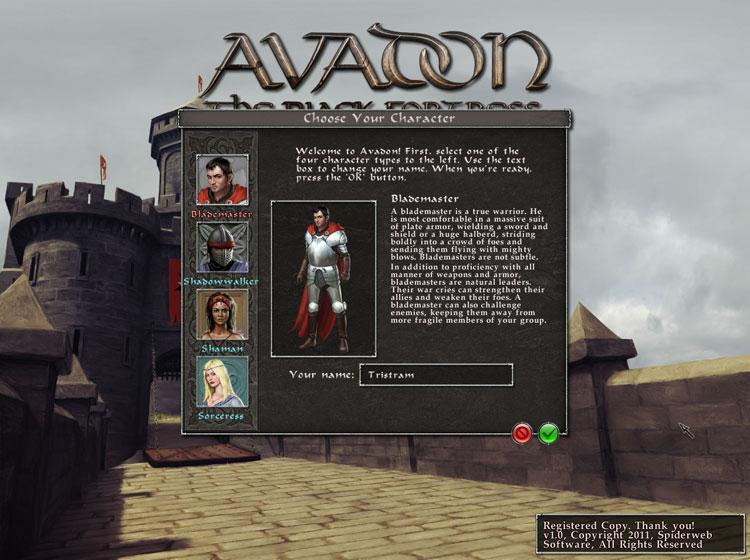
Blademaster
"A blademaster is a true warrior. He is most comfortable in a massive suit of plate armor, wielding a sword and shield or a huge halberd, striding boldly into a crowd of foes and sending them flying with mighty blows. Blademasters are not subtle."
I've tried to stay away from some elements of the standard RPG archetypal class roles: the healer, the crowd control guy, the DPS, etc. But I do like tanks. I like the feeling of having big beefy warriors who stand tall and bear the brunt of the enemy attacks while the other characters stay back and do awesome things. It's not necessary to have a tank in Avadon, but it is a cool option for those who want it.

Blademasters can also stun foes if you get overwhelmed, and they do have the ability to heal themselves. Though they are tanks, I gave them the ability to stun and fling around foes as well to give playing them some variety.

Shadowwalker
"The shadowwalkers are warriors of the shadows. They count on cunning and evasion, slipping through the guards of their enemies and delivering lethal blows. They can attack with blades, thrown razor disks, and pots of noxious and deadly alchemical substances. And then vanish into thin air."
OK, I'm not going to deny or hide the perfectly obvious. Shadowwalkers are suspiciously similar to ninjas. I wanted a character type that was fragile but could inflict a ton of damage in melee and had all sorts of cool tricks. That narrowed it down to ninjas and pirates, and I though ninjas fit better. This is, in come ways, a real pandering, fan-service sort of move, but it has its reasons.

This is my favorite class because of the cool tricks it can do. My favorite are the abilities that let you teleport and stun enemies with smoke or leave a decoy of yourself behind to trick foes. Introducing teleportation into my games has caused some tricky programming issues to deal with, but it's worth it.

And, to be honest, whenever I need to design something in one of my games, my first instinct is to do the thing I would most enjoy if I was playing. That is a compass that has almost never led me astray. And so, when I had the idea of fitting a ninja-type into the world, I was, like, "Yeah! Cool!" It's neat, and it adds a little bit of silliness to a world that sometimes threatened to be dark and serious.

Also, when I write a game, I try to include some elements that appeal to young, energetic fans. For example, the Geneforge series had a lot of in-depth politics and difficult, wrenching, role-playing choices. However, a lot of people bought the games because they liked the idea of having an army of fire-breathing dinosaurs. Avadon does not have fire-breathing dinosaurs, but it has elements of similar, simple fun.

Shaman
"The shaman has dedicated her life to nature, and nature, in return, has rewarded her with great power. She can use her connection to the wilds to heal and bless her allies. And, when angered, she can call wind, lightning, and fire to devastate those who challenge her. A shaman is rarely alone. She can call wolves or, eventually, drakes to serve and protect her. Also, she has the unique ability to heal wounded allies."
I wanted a character who could summon pets, and I wanted a character who had a few healing spells. Those two abilities fit very naturally with the shaman idea, especially since I'd already decided that a large swath of the land of Lynaeus was still settled with fierce, tribal barbarians. The shaman is a class that can do a lot of useful things. Produce damage. Make a pet that can bite or hold off foes. Heal and bless allies. Curse foes. They definitely have the most unique flavor of the classes in the game.

It is worth pointing out, once again, that I am leavening the occasional grimness of the setting and seriousness of the drama with a lot of standard fantasy trappings. Ninjas AND barbarians? What? I've always enjoyed writing games that mix the high-minded and the silly.

Sorceress
"The sorceress has dedicated her life to the mastery of the arcane arts. Fragile in battle, she makes up for it with the ability to summon forth clouds of fire, lightning, or ice, obliterating her foes."
Nothing innovative here. It's not an RPG without a cannon, someone who can summon big ol' tornadoes of fire to wipe everyone out. Fragile, unarmored, but able to blast large areas of the battlefield with raw power. Plus, daze or charm foes, give powerful blessings, and so on. Just keep her a safe distance from the monsters.

I don't feel guilty about having some of the classes be very straightforward and what people are used to in RPGs. I want players to have the option to stay with what they are familiar and comfortable with. The fireball-flinging magic user became a fantasy archetype for a reason.

So Those Are the Classes

Your party will usually have three characters: Your main character, and two others selected from the four helpers available to you, one from each class. (And each with his or her own personality, opinions, and goals.) I've tried to make a good mix of familiar and unusual, combat and melee, with a bit of blatant (but fun) fan service thrown in. I still have months of balance work ahead of me to make sure each class is distinct, useful, and fun, but so far, in practice, the system seems to be working very well in practice.

One Final Note On Gender

I have already received complaints because the two melee fighters are male and the two spellcasters are female. Some want female warriors and some want male casters, and they are unhappy. I can understand their irritation.

The sad truth is that this came about due to limited time and resources. Making the art for the four sorts of PCs already consumed a huge amount of time, even just making one gender per class. When we start work on Avadon 2, one of the first things we hope to do is to make female blademasters and shadowwalkers and male shamans and sorceresses. Until then, certain sacrifices had to be made in the hope of a timely release.

Wednesday, September 8, 2010

Avadon Developer Diary #3 - Character Classes and Kicking Butt


Time for another developer journal about the creation of the first game in an all-new series, Avadon: The Black Fortress. The first article was about the unusual way in which I first came up with the idea for the series, and the second article was about the long and dry process of choosing a mood and theme for the game.

Next came the fun part. The game system. The gritty details of the numbers and abilities and treasures and other things that help make role-playing games fun.

Designing a whole new game system is both fun and terrifying. It's a chance to do something new and exciting, but if you have too many changes your fan base will be angry. It's a chance to correct all the mistakes you made over the previous years, and then go and screw up in a whole new bunch of ways. And there are a lot of decisions to make. Lots and lots of decisions, and a lot of time spent balancing each one.

So, before I got too far, I had to make several big choices:

1. Class-based or skill-based system?


All of Spiderweb's games have had skill-based systems. All characters were able to train in the same pool of skills. Warriors could learn to cast spells. Wizards could learn to use a sword. It's worked very well.

And yet, Avadon will throw all that out the window. Avadon: The Black Fortress will have four character classes, each with entirely different pools of abilities. The classes are Blademaster, Shadowwalker, Shaman, and Sorceress, and each plays very differently.

Your party will have up to three characters. One will be your main character. The other two will be selected from characters in the game, each with their personalities and issues and each of which is one of the four classes.

Three party members. Four classes. Thus, you will always have to do without at least one of the classes. Also, sometimes the characters will be off doing their own business, so you will have to play someone else. Because of this, you will need to shift your tactics occasionally.

So why change? Why throw out a system that's been working great for fifteen years? The answer is: Because I thought it would be fun to write a class-based system.

That's pretty much it. After fifteen years, I need to occasionally try new things to stay interested and keep my brain fresh. Otherwise, burnout, writer's block, and disaster. I've played a lot of good games over the years with class-based systems, I had a lot of fun with them, and I wanted to write my own. And the classes match very well with the different cultures and nations of Lynaeus, so they will be an organic part of the world.

2. How much healing?

All of our games so far have followed a fairly standard computer RPG way of handling damage. Monsters do tons of damage. You have a tank to sop it up and a healer to heal, heal, heal. We've done this a lot. It's fine. But I think it could be more fun.

Instead, for combat, I've been a bit more inspired by the way Dungeons & Dragons and Dragon Age have handled healing. There is not much of it, and it's almost all from potions. Everyone in your party focuses on doing damage. You and the opponent wear each other down, and the first side to fall loses. There is some healing (from Shaman skills and consumable items) for long, tough fights, but combat is now more about being slowly worn down by many blows.

3. How Often Do You Need To Return To Town?

All of our games so far have required frequent trips back to town to rest. As you cast spells, you spell points fade away. Eventually you run out and need to either use precious potions or go back to rest. This system has its points, mainly because it requires you to conserve your power. But walking back to town to rest isn't that fun.

So in Avadon, you will need to return to town far less often. After battles, your health will return quickly. There are no "mana" or "spell points." Abilities will have cooldowns. When you use an ability, you won't be able to use it again for a certain number of turns.

However, as you use more demanding spells and abilities, your fatigue will slowly increase, and when it gets too high you can't use those abilities. However, fatigue really does increase slowly, and there are items that will revive you. The result: Far fewer trips back to town and more time having fun.

4. How Difficult Will the Game Be?

The opinions of my fans has been nearly unanimous on this point. Spiderweb games have gotten too hard. I am completely revamping game balance with this in mind.

The normal, default difficulty will not be tough. Unless you go picking fights with dragons, Avadon will be far less tough that previous games. At the same time, I will make sure that the higher difficulty levels push back at you.

There Are Some Basic Principles

These are the decisions I made early on, which informed everything that came after them. Next month I'll say more about the game system and the character classes.

Thursday, August 5, 2010

Avadon Developer Diary #2 - What Sort Of Game Will This Be?


Here is another long overdue developer diary for our next game, Avadon: The Black Fortress. These articles are about the ongoing process of developing our new series of games. The first installment was about the source of the idea and the basic framework of the plot, which came together fairly quickly.

We recently gave a long interview about Avadon, with a lot of information about the storyline and game system. If you haven't seen it already and want some hard information about what the new game will be like, it's a good place to start.

So I Had the Basic Idea

Now I needed to decide what sort of game I was going to write. So the next step was to decide on the theme, the mood, and the choices. This process took weeks of thought and is worth attention. It might be a little bit technical and vague though, so if you aren't interested in the artsy parts of game design, you should probably wait until the next part, when I get into the game system and the cool number-based hacky-choppy stuff.

Once I had the skeleton of a plot and setting, I think about how the game will "feel". What will the player be doing? How will I get the player emotionally involved? What gripping choices will the player make? You see, I make small budget games. Fancy graphics and sounds aren't going to happen. My main weapon is the ability to tell a good story, so I focus on that. For Avadon to succeed, I have to make it interesting. How do I do that?

The Theme - You Have Power. How Do You Use It?

So first, I need a Theme. This is a set of vague questions and ideas that determine the choices and quests the player will face. When I am designing a new area or town or set of characters, these are the questions I go back to for ideas and inspiration.

So you are a citizen of the Pact, five nations that have banded together to keep the barbarians and monsters at bay. And you work for Avadon, a secretive and powerful force that hunts down and destroys those who would disrupt the safety and stability of the Pact. Avadon's word is law.

Role-playing games work best when they are, at some level, power fantasies. You are a hero (or villain). You have power, and you get to choose how to use it. This has appeal to a lot of gamers, myself included. So the first step is to place the player in a position of power and responsibility. You need to protect your people, and you are given a lot of leeway for how to do it.

But there are also hints that your power is too great. Your word is law, and that isn't necessarily a good thing. Well, it's great for you, but not so hot for everyone else.

Maybe you want to play a thug or a bully. Or maybe you want to resist the temptation to misuse your power, which is satisfying in a different way. And the story of Avadon is about all of the same sorts of choices. Avadon can do what it wants. Will you guide it to do the right thing? And, for that matter, should a group with so much power exist?

That is the theme. Power. The option to misuse it. What will you do?

This is a theme I go back to a lot. I think it leads to interesting games, and a good theme makes coming up with ideas and writing dialogue a lot easier.

The Mood - How Does the Game Feel? Light or Dark?

The next thing to decide is how the game will "feel"? Will it be dark and grim? Bright and cheery? Will there be humor? Will there be detailed descriptions of horror and chaos? How many nice people die?

Based on the theme, Avadon could go very dark. Mass Effect 2 dark, easily. But I decided early on that I don't want that. I like writing humor, and I think games that are too unrelentingly grim aren't very fun.

I decided that Avadon will have a lot of humor and some areas that are fairly cheery. Some of the characters will actually be happy. Sometimes, you will be able to squish evil and make choices you actually feel good about. There will be more confused, cynical moments, of course, but a little of that goes a long way.

A lot of this will show up in Redbeard, the all-powerful master of Avadon. He has much responsibility and power, but I am making him a cheery character, with a lust for life, a macabre sense of humor, and someone who takes true delight in his reach and authority. This character will be the spine of the series, so I want him to be fun to write. And he is.

Of course, these are big games. That makes it easy to have some areas that are light and some areas that are grim. And I will. But, when you are laying down the whole plot, knowing what mood you want at the start helps you get the balance of Neat! and Yuck! right.

The Choices - How Does the Player Change the World?

Finally, choices. I think the most important quality of my games, the thing that adds interest and keeps me interested in writing them, is the ability to make choices that affect the ending. Of course, I'm not the only developer that does this. Bioware is better at it than I am. But it is still something very important to me.

Happily, now that I have the setting and theme, the choice comes naturally. Avadon has almost limitless power, and it can use that power however it wants. Sometimes it uses it for the good of the land, but sometimes corruption sinks in. Avadon has many enemies. The player's choice will be whether to serve Avadon or reject it. Whether to work for Redbeard, master of Avadon, or fight him. Or even plot to replace him.

Choices like this make writing a game much easier. Whenever I design an area and the conversations in it, it provides me a North Star to sail toward. I always skew the choices and conversations toward that final choice, the final destination.

And Then I Have To Write a Game

All of this is a little vague and metaphysical, I know. It is supposed to be. This is all stuff that has to get settled before I write a single line of code. It takes months of thought. But when I'm lost in the wilds, when I have a thousand bug reports and fifty dungeons to design and I'm going crazy, that is too late to figure out what I want the game to be like. I need to put firm clear principles in place so that, when I am exhausted and distracted and just trying to wrap the game up, I have as many questions already answered as I can.

The next diary will be about the next step, the game system, the actual nuts and bolts mechanics of what the game will be like.

Thursday, June 3, 2010

Avadon Developer Diary #1 - Where Ideas Come From.

Last week, after six months of hard work, we were finally able to announce Avadon: The Black Fortress to the world. Avadon is our next, all-new, Indie fantasy role-playing game. And, hopefully, trilogy. We're really excited about it. It's the first time in quite a while that we're doing something really new, and these monthly development diaries will say a bit about the new series and the ups and downs of making it.

So, for the first post, I wanted to write about where the idea came from. I am often asked where I get my ideas. So, if you ever wondered, here is one answer.

The First Idea

About three years ago, I saw that the Avernum and Geneforge series were drawing to a close, and I needed to come up with something new. This was, of course, both exciting and terrifying. Coming up with an idea that will determine the course of years of your life (and possibly put you out of business) is a stressful process.

About this time, my wife and I went to see a Hungarian one-act opera called Bluebeard's Castle. I am normally not a fan of opera. Exactly the opposite, in fact. But some friends had cheap tickets, and we had babysitting, so, you know, whatever.

And what was it like? Well, I will quote Wikipedia.

"The basic plot is loosely based on the folk tale of Bluebeard, but is given a heavily psychological reworking—some would say psychoanalytic or psychosexual"

So you know it was a totally fun time. As far as I'm concerned, an evening out is a failure if it doesn't involve the word "psychosexual."

Anyway. The opera is about Bluebeard, this incredibly scary guy who lives in this huge, dark castle. He brings home his new, young, pretty wife and is showing her around. His castle has seven doors, and he unlocks and opens them for her one after the other. Each door looks out onto some cool room or vista. Some open onto treasures. Others onto subterranean realms. Or far-away lands. (So this is already sounding like a Paper Mario game.) When each door is opened, they sing about it. At length.

So then they get to the last door. Bluebeard refuses to open it. His wife begs for him to. He refuses. This goes on for a while. Finally, Bluebeard gives in and opens the door. Bluebeard's other wives (!) walk out silently. They take his new wife and pull her through the door, which closes behind them. Bluebeard sings about how sad he is. Opera ends. Very psychosexual.

So I'm sitting there watching this, and what I'm thinking is this: Who is this Bluebeard guy? He's very powerful. Very rich. Has a castle full of magic doors. He mentions how he has great influence with the court. What's his deal? Where did all that wealth come from? What does he use those portals for? What is his day job?

And here was my idea. He's a warrior. Or an assassin. Or a spy. He can go wherever the king wants, and do whatever needs doing. Something needs to be found out? Some rebel needs to die? That's what Bluebeard does, and he is well paid for it.

Turning a Glimmer Into a Game

These ideas bounce around in my head for a few years, getting massaged into a more video-game-friendly form. And that brings us to Avadon.

In Avadon, the land of Lynauus is split in two. There is the Pact, an uneasy alliance of five nations, banded together for safety. On the other side is the Farlands, the enemies of the Pact, barbarians and monsters and old, crumbling Empires, kept weak and divided. But they long to get their revenge on the Pact. To put together armies and destroy these upstarts.

And the Pact is protected by Avadon. Avadon is a fortress in the wilds, a law unto itself, separate from the government. Its warriors are tasked to find problems when they are small and do whatever it takes to remove them. Avadon is ruled by Keeper Redbeard, the smiling, jolly, utterly ruthless master of the Black Fortress. He has been in charge for sixty years, though he doesn't appear to have aged a day.

As the game begins, you have just arrived at Avadon's gates. And you have found that, after decades of steely, unbroken control, things are going terribly wrong. Redbeard wants to see you. He needs a pair of fresh eyes, and it is a bad idea to disappoint him.

And that is where the new series came from. Over the next few months, I will say more about the world and the gameplay itself.

Monday, May 31, 2010

Just Announced - Avadon: The Black Fortress.

We have finally, after six months of hard work, gotten our new fantasy RPG series to the point where we can announce it to the world. It will be Avadon: The Black Fortress.

You can now see the screenshots and first details of the story. In the nine months or so it will take to finish the game, we will also be putting monthly development diaries up. That will give nice little breaks from my ranting.

Hope it looks interesting, and we'll have a bunch more information soon.