Tuesday, January 25, 2011
Avadon Developer Diary #5 - Getting It Done.
This will probably be the last developer diary for Avadon: The Black Fortress. We hope to release it for the Macintosh at the end of February. Then the process of porting it to Windows and the iPad shall commence. Of course, I could get the flu or be hit by a truck, which will alter the release schedule slightly.
The first preview of Avadon recently appeared on Inside Mac Games. There's a lot of good information there.
I've already written diaries about the origin of the game, the tone, the sorts of decisions that need to be made, and the character classes. For me, the longest, most grueling part of writing the game is making the scenario. Dungeons have to be designed. Dialogue needs to be written. Gold coins, clay pots, and spoons need to be placed. In other words, the game itself needs to be made.
That process finally ended last week, meaning that we're in the endgame. Time to wrap up all the odd details and kick the game out the door! This is what I generally call the OHGODOHGODITBURNSGETITOFFMEGETITOFFMEEEEEEEEE phase.
This process, during which everyone involved is pretty much running off fumes, has several parts: Odds and Ends, Endgame Balance, Bug Fixing, and Getting the Game Stable.
Odds and Ends
There are always lots of aggravating parts of the job of writing a game that I put off and put off. Now they can't be put off anymore. Every job I hate. Doing the sound effects. And writing the documentation (and hint book). And making the game icon, and the installer. Nothing can be delayed anymore.
A lot of this work is very important, as they determine a player's first impression. Things like the icon and the starting music and art are the first things a player will experience. These details require a lot of attention, so I work on them at a time when I can focus on them as much as possible.
For Avadon, I've put a lot of work into directing the art at the beginning of the game so that they help the player understand a complicated world, with a lot of intricate politics. The early moments of the game can't be wasted. I want to intrigue the player with the story at every possible moment.
Endgame Balance
Balancing the end of the game is particularly difficult. There are several reasons for that. First, there is a wide spread in power levels among players. The dedicated grinders and min-maxers have made characters that are about as powerful as the game allows. More casual players have characters who have fallen farther and farther behind. An encounter that is challenging to a hardcore player will be impossible for a casual player, and an encounter that is tough for a casual player is probably painfully easy for the serious player.
It's a very difficult target to hit, complicated by the fact that at least some of the epic battles at the end of the game should have some pushback to them. They should feel a little tough.
So I try to make the late game fights hard but not impossible for the more casual players. I also try to put in some optional endgame fights that are a real challenge for the toughest players. These two targets are actually tricky to hit precisely, and it requires a lot of feedback and rebalancing.
In Avadon, I want the player to be able to challenge Redbeard for control of the Black Fortress. I want this fight to be soul-crushing, but, with great skill, preparation, and luck, winnable. This is an extra-difficult target to hit. Making something almost impossible is hard. Still, I think I'm getting close.
Bug Fixing and Getting the Game Stable
Of course, this should happen. Now that the game is mostly done, I am getting to the point where everything has been tested and is basically playable. Now that I am trying to actually release the game, I am trying to get it to the most stable, functional point I possibly can.
It's tricky, because Avadon has a lot of player decisions that can make big changes in the ending. Fortunately, my industrious beta testers are doing a great job of trying out all the different possibilities.
This is actually a much more complicated process than it sounds. You see, whenever I make a change, even the most seemingly tiny, innocuous change, there is a chance that I just broke everything.
Games Are Like Giant Cubes of Jello
One of my favorite books on software development describes an unshipped piece of software as a ten by ten by ten foot cube of jello. When you finish it, it is wobbling and shaking. Then, slowly, the vibrations stop and it becomes stable. However, whenever you poke the jello, it starts to wobble again and it takes a long time to become still.
Avadon is a huge cube of jello that is wobbling like mad. As testers play it and don't find serious problems, it stops wobbling. When I make a change, any change at all, I poke it. When the jello is almost still, I go, "OK, I will release the game ... NOW!" and hope it isn't broken. This is how the process works at its best.
So fixing bugs now is a process of triage. When I get a bug report, I think, "Is this serious enough to risk fixing it, bearing in mind that my fix might completely mess up the game?" As we get closer and closer to the ship date, more and more minor issues get kicked off to the v1.0.1 release.
If you've ever wondered why games ship with bugs, this is part of the answer. There is no excuse for releasing a broken game. However, small flaws are always tolerated in order to avoid disaster. Perfection is for v1.0.4.
So Back To Work
If you've been reading these diaries, thank you! I hope I made Avadon sound interesting, and I hope the game is to your liking. It's been a very long road. I've put a lot of myself into this game, and it really is the sort of game I would want to play. Thus, if it turns out to be a failure, I'll have a lot of thinking to do.
Thanks for reading, and I'll see you on the flip side!
Wednesday, January 5, 2011
Three Reasons Creators Should Never Read Their Forums
If I have learned anything from writing Indie games for a living for fifteen years (and there are plenty who would say that I haven't), it is that it is usually a bad idea for creators to visit online forums discussing them and their work. It doesn't lead to happy ends.
This is why big, smart companies with actual budgets hire community people who do nothing but deal with and sift through forums. Managing fans is real work, and picking out the realistic and worthwhile comments takes a ton of time and judgment. That is why smart companies put a layer between the fans and the creators. If you don't have this layer, you should keep a safe, respectful distance.
It's a pity. My company, Spiderweb Software, has a really awesome, active online forum. Been there for years. Always active, full of all sorts of discussions. However, unless I've just released a game and are looking for signs of early, evil bugs, I have to stay away from it.
Some of my fans really resent this and take it personally, and they haven't been shy about letting me know. But if you've ever wondered why the creators of your beloved games often avoid the forums (especially the Word of Warcraft forums, Yeesh!), this might help you to understand why.
1. It's Not Productive To Read How Much People Hate You
It's been said that, if you want a healthy marriage, you have to say five kind things for every unkind thing. It is in our nature to gloss over and ignore kind words, but to really fixate on and get affected by unkind ones. This is why Facebook will never have a Don't Like button. If you see "Joe likes your post," well, fine. If the average online denizen see "Joe doesn't like this," he or she will probably freak out.
Which brings us to forums.
A few years ago, I wrote an article for IGN about how I felt that Indie games were far from the only source of innovation, and the big companies don't get enough credit for trying to make innovative things. Slashdot was kind enough to link to it. Someone might agree or disagree with me. Fine. But someone wrote this ...
WHOA! DUDE! What did I ever do to you? Did I run over your dog? Make out with your mom? Go to where you work and mess up the settings on the fry vat? Damn!
Now, I thought that one was pretty funny. I sent links to it to my friends, saying, "Hey! Look what people REALLY think of me!" Over the years, I've developed a pretty thick skin. And yet, if you read lots of people dumping on you, unless you have super-human emotional control, it's eventually going to get to you. Sometimes I'll get weak and look at a forum and see some nasty cheap shot and it'll throw me off my game for hours.
Remember, as Penny Arcade put it (in a far superior and NSFW way), anonymity plus audience makes assholes. (And, for what it's worth, the creators of Penny Arcade don't read their forums either.)
It's a little different on my company's forums. But only a little. Even though it is mainly populated by my fans, it is still full of shots at my design skill, game quality, virility, and facial complexion. Remember, there's a thin line between love and hate. Nobody will lash out at you like a disappointed fan.
When I read the forums for, say, World of Warcraft or xkcd, I'm always amazed at how nasty things get. It makes me think, "If you hate it so much, why are you there?" But that's just the way it is, and excess exposure to insults can really get under your skin, make you doubt yourself, and interfere with your work. It's very sad, but you sometimes need to just protect yourself by staying away. Keep your brain clean.
2. It's Not Going To Be Helpful
It seems like reading forums would be a good way to get design ideas and learn ways to improve your games. With the exception of learning about bugs, this is usually not the case.
It can be tempting, when you're stuck designing a game, to read forums and look for feedback. The problem is this. No matter what the question is, there are people who will advocate strongly for both sides of it. Many of these people reflexively hate change. Many of these people are only happy if the game is much harder (or much easier). Some of them will not, in fact, have a realistic idea about anything. Often, there are issues where intelligent people can come to opposite conclusions, and you can read thousands of furious posts on either side of the issue without getting an inch closer to an actual decision.
Forums contain a cacophony of people telling you to do diametrically opposite things, very loudly, often for bad reasons. There will be plenty of good ideas, but picking them out from the bad ones is unreliable and a lot of work. If you try to make too many people happy at once, you will drive yourself mad. You have to be very, very careful who you let into your head.
Of course, it is still very important for designers to get lots of good, constructive criticism. That is why I have built up an elite cadre of awesome beta testers and interested friends, and I listen to them very closely. And, I must point out, many of those testers were recruited from my forums. You just need to choose carefully the people you ask for advice.
3. You Might Get Suckered Into Getting Angry
Not much to say about this. If you read forums for long enough, you will read a lot of nasty comments and cheap shots. If you read enough cheap shots, you'll get angry. If you are angry enough, you will eventually lash out and flame back.
Snapping angrily at your customers never, ever leads to good results.
One Final Comment
I'm sure some of my fellow Indie developers are reading this and shaking their heads at my idiocy. A lot of developers do maintain close relationships with their forums. It works for them, for now. I'm glad for them, and I hope it keeps working.
Just bear this in mind. When you start out and gain your first following, you get a grace period. You're a fresh face, making awesome new things. Everyone loves you. And, most importantly, you haven't had a chance to start disappointing chunks of your fan base yet.
The longer you are active, the more of your fans will turn on you, justified or not.
And, if you are a member of my forums reading this, know this. I love you guys. The idea that anyone wants to discuss my work at all, even to dump on it, is insanely flattering. I just hope that this makes clearer the instincts of efficiency and self-preservation that lead me to keep a little bit of distance.
Edit: Changed "think skin" to "thick skin."
This is why big, smart companies with actual budgets hire community people who do nothing but deal with and sift through forums. Managing fans is real work, and picking out the realistic and worthwhile comments takes a ton of time and judgment. That is why smart companies put a layer between the fans and the creators. If you don't have this layer, you should keep a safe, respectful distance.
It's a pity. My company, Spiderweb Software, has a really awesome, active online forum. Been there for years. Always active, full of all sorts of discussions. However, unless I've just released a game and are looking for signs of early, evil bugs, I have to stay away from it.
Some of my fans really resent this and take it personally, and they haven't been shy about letting me know. But if you've ever wondered why the creators of your beloved games often avoid the forums (especially the Word of Warcraft forums, Yeesh!), this might help you to understand why.
1. It's Not Productive To Read How Much People Hate You
It's been said that, if you want a healthy marriage, you have to say five kind things for every unkind thing. It is in our nature to gloss over and ignore kind words, but to really fixate on and get affected by unkind ones. This is why Facebook will never have a Don't Like button. If you see "Joe likes your post," well, fine. If the average online denizen see "Joe doesn't like this," he or she will probably freak out.
Which brings us to forums.
A few years ago, I wrote an article for IGN about how I felt that Indie games were far from the only source of innovation, and the big companies don't get enough credit for trying to make innovative things. Slashdot was kind enough to link to it. Someone might agree or disagree with me. Fine. But someone wrote this ...
"This is the kind of commentary I'd expect out of a cynical independent ripoff artist in action, really. You know, the kind of person who is too afraid and closed-minded to try anything new, partly because he doesn't want to lose his money or reputation - a sound judgement - and partly because he just doesn't seem to want to try. ... In other words, nothing to see here. Just near-mindless droning from another cynic with a rather skewed and defeated view of the gaming world."
WHOA! DUDE! What did I ever do to you? Did I run over your dog? Make out with your mom? Go to where you work and mess up the settings on the fry vat? Damn!
Now, I thought that one was pretty funny. I sent links to it to my friends, saying, "Hey! Look what people REALLY think of me!" Over the years, I've developed a pretty thick skin. And yet, if you read lots of people dumping on you, unless you have super-human emotional control, it's eventually going to get to you. Sometimes I'll get weak and look at a forum and see some nasty cheap shot and it'll throw me off my game for hours.
Remember, as Penny Arcade put it (in a far superior and NSFW way), anonymity plus audience makes assholes. (And, for what it's worth, the creators of Penny Arcade don't read their forums either.)
It's a little different on my company's forums. But only a little. Even though it is mainly populated by my fans, it is still full of shots at my design skill, game quality, virility, and facial complexion. Remember, there's a thin line between love and hate. Nobody will lash out at you like a disappointed fan.
When I read the forums for, say, World of Warcraft or xkcd, I'm always amazed at how nasty things get. It makes me think, "If you hate it so much, why are you there?" But that's just the way it is, and excess exposure to insults can really get under your skin, make you doubt yourself, and interfere with your work. It's very sad, but you sometimes need to just protect yourself by staying away. Keep your brain clean.
2. It's Not Going To Be Helpful
It seems like reading forums would be a good way to get design ideas and learn ways to improve your games. With the exception of learning about bugs, this is usually not the case.
It can be tempting, when you're stuck designing a game, to read forums and look for feedback. The problem is this. No matter what the question is, there are people who will advocate strongly for both sides of it. Many of these people reflexively hate change. Many of these people are only happy if the game is much harder (or much easier). Some of them will not, in fact, have a realistic idea about anything. Often, there are issues where intelligent people can come to opposite conclusions, and you can read thousands of furious posts on either side of the issue without getting an inch closer to an actual decision.
Forums contain a cacophony of people telling you to do diametrically opposite things, very loudly, often for bad reasons. There will be plenty of good ideas, but picking them out from the bad ones is unreliable and a lot of work. If you try to make too many people happy at once, you will drive yourself mad. You have to be very, very careful who you let into your head.
Of course, it is still very important for designers to get lots of good, constructive criticism. That is why I have built up an elite cadre of awesome beta testers and interested friends, and I listen to them very closely. And, I must point out, many of those testers were recruited from my forums. You just need to choose carefully the people you ask for advice.
3. You Might Get Suckered Into Getting Angry
Not much to say about this. If you read forums for long enough, you will read a lot of nasty comments and cheap shots. If you read enough cheap shots, you'll get angry. If you are angry enough, you will eventually lash out and flame back.
Snapping angrily at your customers never, ever leads to good results.
One Final Comment
I'm sure some of my fellow Indie developers are reading this and shaking their heads at my idiocy. A lot of developers do maintain close relationships with their forums. It works for them, for now. I'm glad for them, and I hope it keeps working.
Just bear this in mind. When you start out and gain your first following, you get a grace period. You're a fresh face, making awesome new things. Everyone loves you. And, most importantly, you haven't had a chance to start disappointing chunks of your fan base yet.
The longer you are active, the more of your fans will turn on you, justified or not.
And, if you are a member of my forums reading this, know this. I love you guys. The idea that anyone wants to discuss my work at all, even to dump on it, is insanely flattering. I just hope that this makes clearer the instincts of efficiency and self-preservation that lead me to keep a little bit of distance.
Edit: Changed "think skin" to "thick skin."
Wednesday, December 15, 2010
December Odds, Ends, and Rock Band 3.
A few mixed things for the month ...
Hear Me Talk About ME!
There is a nice interview of me up in Inside Mac Games. I got to say a lot of things about the game industry, Macs, DRM, and our upcoming game, Avadon: The Black Fortress. I haven't gotten lots of e-mails yet about how wrong and dumb I am, so the interview was probably a failure. But you might find it interesting.
Die, Bunny! Die!
One thing I forgot to mention about Red Dead: Redemption. I spent a lot of time hunting animals, for money, for cheevos, and to break the monotony of long horsey rides.
At one point, I shot a rabbit but only grazed it. It started flailing around on the ground in tormented agony.
Animating characters is difficult, time-consuming, and expensive. And yet, someone at Rockstar took the time to animate a crippled bunny. This is the sort of excessive, terrifying craftsmanship that keeps me coming back to their games.
Pity that you don't have a radio, ala Grand Theft Auto. It wouldn't be historically accurate, but I would have loved to borrow 99 Luftballoons from Grand Theft Auto: Vice City to keep my energy levels up during long rides across Mexico.
Last Thoughts About Red Dead: Redemption
I finished Red Dead: Redemption, and I enjoyed that game as much as any I've played in a long time. The last time I wrote about it, I heard from some people who were infuriated by the awkwardness going through doors. I suppose the doors could be better, but you really spend very little of the game in places that even have doors.
(Minor spoilers ahead.)
One thing I really loved about the game: The storyline in the last ten missions or so. You see, in most games, after you kill the Head Bad Guy, that's it. You're done. Cutscene, credits, and out. But in this game, after the bad guy is gone, you then have a bunch of missions at your home. You meet your family, try to relate to your son, and work to rebuild your farm.
These missions are quiet, simple, and really quite affecting. It helps a lot that the relationships between John Marston and his wife and son are very nicely done. I really felt for them as characters and it made the last chunk of the game much more engaging. Which might make it a little bit relevant to that whole, tedious "Are games art?" argument that keeps resurfacing, no matter how much we might wish it'd stop.
Rock Band 3 Reviewish Thing
I've never hidden my huge love of Rock Band, and I've written about the series on several occasions. However, I can't work up the energy to write a Rock Band 3 review. It's got a lot of awesome songs, fantastic interface improvements, some nicely done Pro Modes that only 1% of the players will care about, and a keyboard.
But music games are a fad that is slowly choking on its own blood. Don't believe me? Look at it this way. When your development house releases its classic for the ages, and, a couple of weeks later, your owner puts you up for sale, well, not so good.
And, while the keyboard is a nice little bit of variety, it's just more of the same simple "Hit the green button. Now hit the yellow button." gameplay that most people have gotten totally tired of by now. It won't save the genre, and, considering that my half-assed efforts easily put me high up on the leaderboards, not many people are playing.
But hey, I'm a dead-ender. You'll have to pry my fakey drumsticks from my cold dead fingers. And I just dropped twenty bucks for the new Billy Joel pack. I will keep enjoying this niche genre for a while longer. But it will never again be anything but a niche genre.
Hear Me Talk About ME!
There is a nice interview of me up in Inside Mac Games. I got to say a lot of things about the game industry, Macs, DRM, and our upcoming game, Avadon: The Black Fortress. I haven't gotten lots of e-mails yet about how wrong and dumb I am, so the interview was probably a failure. But you might find it interesting.
Die, Bunny! Die!
One thing I forgot to mention about Red Dead: Redemption. I spent a lot of time hunting animals, for money, for cheevos, and to break the monotony of long horsey rides.
At one point, I shot a rabbit but only grazed it. It started flailing around on the ground in tormented agony.
Animating characters is difficult, time-consuming, and expensive. And yet, someone at Rockstar took the time to animate a crippled bunny. This is the sort of excessive, terrifying craftsmanship that keeps me coming back to their games.
Pity that you don't have a radio, ala Grand Theft Auto. It wouldn't be historically accurate, but I would have loved to borrow 99 Luftballoons from Grand Theft Auto: Vice City to keep my energy levels up during long rides across Mexico.
Last Thoughts About Red Dead: Redemption
I finished Red Dead: Redemption, and I enjoyed that game as much as any I've played in a long time. The last time I wrote about it, I heard from some people who were infuriated by the awkwardness going through doors. I suppose the doors could be better, but you really spend very little of the game in places that even have doors.
(Minor spoilers ahead.)
One thing I really loved about the game: The storyline in the last ten missions or so. You see, in most games, after you kill the Head Bad Guy, that's it. You're done. Cutscene, credits, and out. But in this game, after the bad guy is gone, you then have a bunch of missions at your home. You meet your family, try to relate to your son, and work to rebuild your farm.
These missions are quiet, simple, and really quite affecting. It helps a lot that the relationships between John Marston and his wife and son are very nicely done. I really felt for them as characters and it made the last chunk of the game much more engaging. Which might make it a little bit relevant to that whole, tedious "Are games art?" argument that keeps resurfacing, no matter how much we might wish it'd stop.
Rock Band 3 Reviewish Thing
I've never hidden my huge love of Rock Band, and I've written about the series on several occasions. However, I can't work up the energy to write a Rock Band 3 review. It's got a lot of awesome songs, fantastic interface improvements, some nicely done Pro Modes that only 1% of the players will care about, and a keyboard.
But music games are a fad that is slowly choking on its own blood. Don't believe me? Look at it this way. When your development house releases its classic for the ages, and, a couple of weeks later, your owner puts you up for sale, well, not so good.
And, while the keyboard is a nice little bit of variety, it's just more of the same simple "Hit the green button. Now hit the yellow button." gameplay that most people have gotten totally tired of by now. It won't save the genre, and, considering that my half-assed efforts easily put me high up on the leaderboards, not many people are playing.
But hey, I'm a dead-ender. You'll have to pry my fakey drumsticks from my cold dead fingers. And I just dropped twenty bucks for the new Billy Joel pack. I will keep enjoying this niche genre for a while longer. But it will never again be anything but a niche genre.
Friday, December 3, 2010
Red Dead: Redemption and My Failures As a Parent
Before I take a weekend-long break from writing Avadon to spend a weekend with the family in my favorite place in the world, I wanted to talk about my latest gaming obsession.
Red Dead: Redemption
Since I'm an enormous fan of Rockstar's violent, objectionable sandbox games, and the only person you will ever meet who actually played Grand Theft Auto IV all the way to the end, I'm surprised it took me so long to get around to playing this. It's Grand Theft Auto, but in the old west. So instead of stealing cars, you steal stagecoaches! Instead of killing hundreds of Mexicans in fake L.A., you kill them in real Mexico!
What was more surprising, though in retrospect it should not have been, was how instantly attached my eight year old daughter became to the game the moment she caught an unlucky glimpse of me playing it. Of course, it makes perfect sense. This is a game where you own a horse, ride your horse, take your horse out into the brush, find wild horses, capture and tame wild horses, and make one of those horses your new horse.
So she wanted to play it. A lot. But it's a Rockstar game, with all of the obscenity, gruesome violence, and graphic sexuality that entails. (Along with an unusually high frequency of rape, which I don't consider an improvement.)
So I let her play the game, but only in sandbox mode. She got stuck early on in the missions, and I haven't helped her. Thus, the things she are exposed to while questing for horses are only damaging, not totally traumatizing.
Of course, when I walked into the living room yesterday, I saw her chasing down a pack of bandits and shooting them all in the back in an admirably businesslike fashion. Also, she is trying to hunt down every animal in the game. She'll say, "Daddy! I shot a snake! And an armadillo!" And she'll bounce up and down like the happiest little girl in the world.
So I either suck at parenting or am really fantastic at it.
Two Key Differences Between Red Dead: Redemption and Grand Theft Auto
In Grand Theft Auto, when I left my car to go on some dangerous mission and returned to it later with like eighty guys chasing me and a need to get away very quickly, I never found that my car was missing because it wandered off to eat a particularly tasty clump of grass a half a mile away.
In Grand Theft Auto, when I was peacefully driving somewhere, my car was never suddenly killed by a cougar, who then ate me.
I mean, sure, sometimes gang members would shoot at me, but this was never really a problem. Gangbangers with AK-47s are a walk in the park compared to cougars. Cougars are serious business.
Oh, and Some Shameless Self-Promotion
In October, we had our 15th anniversary sale, celebrating an alarmingly long time being in the business of writing Indie role-playing games. The sale was a huge success, one of the best sales we've ever had. As a result, and as a thank you to everyone who has been nice enough to keep us in business all these years, we are resuming the most popular part of the sale: the big discount on CD bundles. For the entire month of December, all of our Game Collections on CD are 25% off.
Red Dead: Redemption
Since I'm an enormous fan of Rockstar's violent, objectionable sandbox games, and the only person you will ever meet who actually played Grand Theft Auto IV all the way to the end, I'm surprised it took me so long to get around to playing this. It's Grand Theft Auto, but in the old west. So instead of stealing cars, you steal stagecoaches! Instead of killing hundreds of Mexicans in fake L.A., you kill them in real Mexico!
What was more surprising, though in retrospect it should not have been, was how instantly attached my eight year old daughter became to the game the moment she caught an unlucky glimpse of me playing it. Of course, it makes perfect sense. This is a game where you own a horse, ride your horse, take your horse out into the brush, find wild horses, capture and tame wild horses, and make one of those horses your new horse.
So she wanted to play it. A lot. But it's a Rockstar game, with all of the obscenity, gruesome violence, and graphic sexuality that entails. (Along with an unusually high frequency of rape, which I don't consider an improvement.)
So I let her play the game, but only in sandbox mode. She got stuck early on in the missions, and I haven't helped her. Thus, the things she are exposed to while questing for horses are only damaging, not totally traumatizing.
Of course, when I walked into the living room yesterday, I saw her chasing down a pack of bandits and shooting them all in the back in an admirably businesslike fashion. Also, she is trying to hunt down every animal in the game. She'll say, "Daddy! I shot a snake! And an armadillo!" And she'll bounce up and down like the happiest little girl in the world.
So I either suck at parenting or am really fantastic at it.
Two Key Differences Between Red Dead: Redemption and Grand Theft Auto
In Grand Theft Auto, when I left my car to go on some dangerous mission and returned to it later with like eighty guys chasing me and a need to get away very quickly, I never found that my car was missing because it wandered off to eat a particularly tasty clump of grass a half a mile away.
In Grand Theft Auto, when I was peacefully driving somewhere, my car was never suddenly killed by a cougar, who then ate me.
I mean, sure, sometimes gang members would shoot at me, but this was never really a problem. Gangbangers with AK-47s are a walk in the park compared to cougars. Cougars are serious business.
Oh, and Some Shameless Self-Promotion
In October, we had our 15th anniversary sale, celebrating an alarmingly long time being in the business of writing Indie role-playing games. The sale was a huge success, one of the best sales we've ever had. As a result, and as a thank you to everyone who has been nice enough to keep us in business all these years, we are resuming the most popular part of the sale: the big discount on CD bundles. For the entire month of December, all of our Game Collections on CD are 25% off.
Tuesday, November 23, 2010
Review - Super Meat Boy
I recently played Super Meat Boy on XBox Live. It is a really fun game, and it manages innovation in a genre that I would have thought had passed innovation by decades ago. It's an impressive feat, and very much worth some attention.
Super Meat Boy is a 2-D platformer. Like all other successful indie games. Ninety percent of all indie games have to be 2-D platformers now, by federal law. Penalties for violation start at being forced to watch all of the Wandering Around In the Forest Being Emo scenes from Harry Potter and the Deathly Hallows and rapidly get worse from there.
The plot is simple, elemental, and timeless. You play Meat Boy, a small, sentient wad of bloody meat. Your girlfriend, Bandage Girl, has been kidnapped by the evil Dr. Fetus. You have to rescue her. You do so by moving left and right and jumping, hopefully evading all obstacles on your way to get to Bandage Girl. That's it. That's the game. It's a bloodier (MUCH bloodier) version of Donkey Kong, which itself came out about the time Napoleon was getting bogged down in Russia.
And yet, it is insanely fun and amazingly innovative. And the innovation comes from the developers' attempt to answer this simple question:
How do you make a computer game that is extremely hardcore and difficult but, at the same time, light and fun and not frustrating?
Tough problem. And they come up with a great solution. Super Meat Boy has two innovations that make it unique:
1. Short, short levels. No death penalty.
Super Meat Boy is a tough platformer, one of the toughest you will ever play. However, the levels are short. Very short. A lot of them can be completed in less than five seconds. Practically all of them can be done in less than thirty. For all regular gameplay, you don't have "lives". There is no long, annoying death animation. When you die, you are instantly back at the start of the level and able to play again. In other words, you come back to life so fast you will be playing again before you fully realize that you died.
Super Meat Boy requires amazingly difficult jumps, dodges, maneuvers, etc. It can easily take fifty tries to finish a level. And yet, you will often have all of those deaths less than five seconds into a level. So fifty deaths sounds like a lot, but they take place in less that 250 seconds (four minutes or so), which is an entirely reasonable amount of time to spend completing a level.
And when, by some unholy combination of skill and luck, you reach that fifth minute and maneuver through a tough level, you feel like a gaming god.
2. The Awesome Replays
When you finish a level, you see a replay of your attempts. Sounds dull, yes? The difference here is that you see a replay of ALL your attempts, shown at once. You die fifty times before you win? Then the replay shows fifty-one Meat Boys running through the level simultaneously. Fifty of them die in explosions of gore, and one of them gets through. It looks really cool and funny, and you can save the replays and show them to your friends.
The really amazing thing about this feature is subtle but powerful. What the all-attempts replays mean is that every time you die you didn't just waste your time. You added one more Meat Boy to the final replay, making it look cooler. Die fifty times? Then the replay looks spectacular. You aren't just failing. You're creating a bit of video game art. This feature sometimes made me keep trying a level again and again even after my sore fingers begged me to stop, just because I knew that, when I won, the replay would be awesome.
Video game death as personal expression. How cool is that?
There's More
There's many levels in the game. Finish a level quickly enough and it unlocks a much more difficult "dark world" version of the level. Plus there are boss fights. Hidden characters. Secret bonus levels. It's one of the best examples I've ever seen of obsessed developers going the extra mile to add craftsmanship and polish to their labor of love. The controls are really tight. The cutscenes are hilarious. Seriously, play this game.
I am on the record as saying that indie game development is overrated from the perspective of innovation. There are plenty of indie developers making hackwork, genre pieces, and clones of more successful games, and EA has published plenty of innovative titles over the last few years. But this is definitely one game that argues for the specialness of indies, and it's definitely worth checking out.
Thursday, November 11, 2010
Review - Starcraft 2: Wings of Liberty
This is pretty late, but I've taken some time off from writing my games to produce a quick review of Starcraft 2: Wings of Liberty. I'm only reviewing the single-player portion, as playing the game on multiplayer for more than 15 seconds makes me feel like I'm going to have a stroke. I'm still trying to remember which button makes me build a barracks, and when fifty laser ninjas are crashing through my perimeter. It makes me hate myself.
TL;DR Summary: Really fun game. Really dopey story, but it doesn't matter, because in games like this all the story has to be is a placeholder, a floppy useless thing that hangs off the side and is ignored by everyone. Also, computer games can be art, but, secretly, nobody really wants them to be.
So. The Starcraft 2 campaign. Very interesting stuff. There's really two parts of it. The story and the missions.
1. The Story
But, you might ask, why bother to review a story in a game like this? I mean, sure, games like this and Halo and Gears of War have goofy storylines. Everyone knows they're goofy. They will always be goofy. So why bother saying it?
Well, to answer your hypothetical question, imaginary reader, whenever a game makes you spend time experiencing something, it is fair to evaluate that experience. If you take my time up with something, it's worthwhile to ask whether said time was worth spending. Also, Blizzard spent a ton of money making that story, with the cutscenes and the voice acting and whatnot, so it's fun to ask whether they got their money's worth. A few comments are entirely justified.
The story to Starcraft 2 is what you would get if the stories of Firefly and Gears of War had a drunken hookup. I swear, the writers of Starcraft 2 wanted to be making a lost episode of Firefly so bad that it was almost poignant. The western theme, the mood, the accents, the train-robbery mission, even the dang music cues.
But the story itself is pretty painful. Cheesy dialogue. Bland characters. Aimless storytelling where very little interesting happens. And, considering that this is the story of how an endless horde of bug-creatures eats nine-tenths of humanity, making it kind of dull is a real achievement.
There are two things I would do to fix a storyline like this. If one real game writer working for a real company reads what I write and thinks, "Hmmm. He might have a point," I can die happily knowing I made the world a better place.
War Is Interesting. Don't Neglect the War.
The whole game is basically about a war between people and bug creatures. War is one of the most fascinating things you can tell a story about. The cunning generals. The terrified soldiers. The major battles. The tactics and turnabouts. There is limitless drama in the story of a war.
But, in the story of Starcraft 2: Wings of Liberty, the war itself is usually only seen in cutscenes or on the news show you can watch on the TV in the bar. Most of the stuff you do in the game has nothing to do with the war. You're learning about some Protoss prophecy. You're gathering parts of some crystal artifacts. You are gathering supplies for some crazy guy so he can do some thing. You don't engage the bug creatures in a big, meaningful way until like 90% of the way into the game.
It's like if I was telling the story of World War 2 and never mentioned anything about D-Day or the Battle of the Bulge. Instead, it's the story of how a bunch of guys went to Madagascar to find the three parts of a magic laser that would win the war by killing Hitler. I'm sorry, but this is not the best use of your dramatic material.
Make What You Do Have a Point
So this is what happened. In the story, some crazy guy has me spend two missions gathering materials for some super space gun or something. Then a pretty space girl with psychic space powers comes to me and tells me I need to kill him. I choose to believe her, so I spend a whole mission laboriously destroying the supplies I spend the earlier missions gathering.
So that was four whole missions (two to gather supplies, two potential missions for what happens to them), a whole seventh of the game, getting stuff and then destroying it, achieving exactly nothing. What a waste of precious storytelling space.
One of the best things to do with the story in a video game is to make the player feel all badass. Killing fifty space mans with your space gun is already awesome. Knowing you are doing this to save the space princess from the space bugs gives the power fantasy a nice little kick. Players like knowing that their actions are making a difference. Maybe completing the mission has a good effect. Maybe a bad effect. But you should make sure that the mission the player just spent time and effort completing makes a difference. Doing otherwise is unwise. Never invite the player to think his or her actions in the game are meaningless.
2. The Level Design
There was some angst online when it was announced that the storyline for Starcraft 2 was going to be split into three full games, of which Starcraft 2: Wings of Liberty was the first. Understandably, there were complaints about having to pay for three games instead of one for the same story. Now that I've played the first game, I can say this. If the superb level design of the first game continues through the next two, splitting the thing into three games is great news. The story is a bit blah, but the game itself is a huge amount of fun.
First off, the designers saw that the core gameplay of Starcraft 2 is really fun. You build a base, make it stronger, make badass troops, and send them out to kill things. So that is the main structure of most of the missions, but with the added kindness of usually making sure the core elements of your base have been built, to save you the tedium of mining a bunch of unobtanium and building a barracks for the eighty thousandth time.
However, while the spine of the gameplay is the same, every mission is different, with the variety coming in what you fight or what your goals are. One mission requires you to blow up trains as they speed quickly across the level. Another mission takes place on a planet being scoured by fire, so you need to quickly leapfrog your base to the right, fighting foes as you go.
There are several defense missions and a handful of "Tiny number of units sneaking through a big fort" missions, enough to add variety but not enough to distract from the main mode gameplay. Also, there are a million different units you can build, most of which you will forget and never use again. However, each unit has one mission designed to use its particular strengths, so all of that work making new graphics models won't go to waste.
So, yeah, once I figured out that the Escape key would bump me past most of the plot, I had lots and lots of fun playing Starcraft 2: Wings of Liberty.
So What Does This Mean?
That all the time they spent making the story and all of the time I spent writing about it and all of the time you spent reading it was kind of a waste. The story didn't matter. The game was a lot of fun, and it would have been even if all of the cutscenes depicted my protagonist sitting on the couch or yelling at space elves.
Games in stories are usually a vestigial limb. Every once in a while, I play a game that is improved by its story. (Most of these titles are by Bioware.) A story can provide excellent context. On the other hand, who cares about context? Most of the time, people just want to melt faces. While it can be nice to know whose faces they are and for what reason said melting is occurring, it's not necessary.
While I do believe that games can sometimes be art, they really, really don't need to be. It gives me a lot of sympathy for the people who say they can't be art. The "artistic content" part usually has nothing to do with the "fun" part, and the "fun" part was really all I cared about. Zap! Zap! Pew! Pew!
It's like I've said for quite a while, "Players will forgive you for making a good story, as long as you allow them to ignore it." It's a weird thing for someone like me to say, since the stories in my games are one of the main selling points. But, at some point, I can't ignore what people actually go out and play. Myself included.
Thursday, November 4, 2010
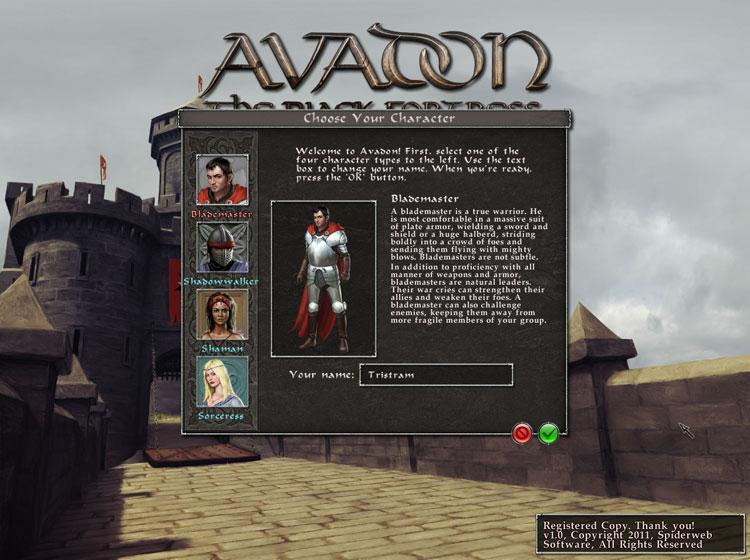
Avadon Developer Diary #4 - The Character Classes
Avadon: The Black Fortress, our next game and the beginning of an all-new series, has been in beta-testing for a while. It's been a grueling process. Testing a new game with a new engine is a lot of work, because basically everything in the game is broken. Happily, we've worked through the worst of it, and Spiderweb Software is still on track to release the game for the Mac in February.
For this developer diary (the others are here, here, and here), I wanted to write about the four character classes in Avadon. What they are, what they are like, and why I made them the way I did. Since this is the very first time I've written a class-based system, I put an awful lot of thought into the classes. I wanted each to have a distinct feel, but I want you to be able to complete the game with any mix of them.
Since I don't want the game to have too much healing, all classes needed to be able to protect themselves in some way. Since any combination of them needed to be able to win, I wanted them all to be able to produce a bunch of damage when necessary. And since I wanted them to be distinct, each of them needed to be able to do something unique and, hopefully, interesting.
So here they are. I will give the name of each class, the official, in-game description, and what I was thinking when I put it in.
Blademaster
"A blademaster is a true warrior. He is most comfortable in a massive suit of plate armor, wielding a sword and shield or a huge halberd, striding boldly into a crowd of foes and sending them flying with mighty blows. Blademasters are not subtle."I've tried to stay away from some elements of the standard RPG archetypal class roles: the healer, the crowd control guy, the DPS, etc. But I do like tanks. I like the feeling of having big beefy warriors who stand tall and bear the brunt of the enemy attacks while the other characters stay back and do awesome things. It's not necessary to have a tank in Avadon, but it is a cool option for those who want it.
Blademasters can also stun foes if you get overwhelmed, and they do have the ability to heal themselves. Though they are tanks, I gave them the ability to stun and fling around foes as well to give playing them some variety.
Shadowwalker
"The shadowwalkers are warriors of the shadows. They count on cunning and evasion, slipping through the guards of their enemies and delivering lethal blows. They can attack with blades, thrown razor disks, and pots of noxious and deadly alchemical substances. And then vanish into thin air."OK, I'm not going to deny or hide the perfectly obvious. Shadowwalkers are suspiciously similar to ninjas. I wanted a character type that was fragile but could inflict a ton of damage in melee and had all sorts of cool tricks. That narrowed it down to ninjas and pirates, and I though ninjas fit better. This is, in come ways, a real pandering, fan-service sort of move, but it has its reasons.
This is my favorite class because of the cool tricks it can do. My favorite are the abilities that let you teleport and stun enemies with smoke or leave a decoy of yourself behind to trick foes. Introducing teleportation into my games has caused some tricky programming issues to deal with, but it's worth it.
And, to be honest, whenever I need to design something in one of my games, my first instinct is to do the thing I would most enjoy if I was playing. That is a compass that has almost never led me astray. And so, when I had the idea of fitting a ninja-type into the world, I was, like, "Yeah! Cool!" It's neat, and it adds a little bit of silliness to a world that sometimes threatened to be dark and serious.
Also, when I write a game, I try to include some elements that appeal to young, energetic fans. For example, the Geneforge series had a lot of in-depth politics and difficult, wrenching, role-playing choices. However, a lot of people bought the games because they liked the idea of having an army of fire-breathing dinosaurs. Avadon does not have fire-breathing dinosaurs, but it has elements of similar, simple fun.
Shaman
"The shaman has dedicated her life to nature, and nature, in return, has rewarded her with great power. She can use her connection to the wilds to heal and bless her allies. And, when angered, she can call wind, lightning, and fire to devastate those who challenge her. A shaman is rarely alone. She can call wolves or, eventually, drakes to serve and protect her. Also, she has the unique ability to heal wounded allies."I wanted a character who could summon pets, and I wanted a character who had a few healing spells. Those two abilities fit very naturally with the shaman idea, especially since I'd already decided that a large swath of the land of Lynaeus was still settled with fierce, tribal barbarians. The shaman is a class that can do a lot of useful things. Produce damage. Make a pet that can bite or hold off foes. Heal and bless allies. Curse foes. They definitely have the most unique flavor of the classes in the game.
It is worth pointing out, once again, that I am leavening the occasional grimness of the setting and seriousness of the drama with a lot of standard fantasy trappings. Ninjas AND barbarians? What? I've always enjoyed writing games that mix the high-minded and the silly.
Sorceress
"The sorceress has dedicated her life to the mastery of the arcane arts. Fragile in battle, she makes up for it with the ability to summon forth clouds of fire, lightning, or ice, obliterating her foes."Nothing innovative here. It's not an RPG without a cannon, someone who can summon big ol' tornadoes of fire to wipe everyone out. Fragile, unarmored, but able to blast large areas of the battlefield with raw power. Plus, daze or charm foes, give powerful blessings, and so on. Just keep her a safe distance from the monsters.
I don't feel guilty about having some of the classes be very straightforward and what people are used to in RPGs. I want players to have the option to stay with what they are familiar and comfortable with. The fireball-flinging magic user became a fantasy archetype for a reason.
So Those Are the Classes
Your party will usually have three characters: Your main character, and two others selected from the four helpers available to you, one from each class. (And each with his or her own personality, opinions, and goals.) I've tried to make a good mix of familiar and unusual, combat and melee, with a bit of blatant (but fun) fan service thrown in. I still have months of balance work ahead of me to make sure each class is distinct, useful, and fun, but so far, in practice, the system seems to be working very well in practice.
One Final Note On Gender
I have already received complaints because the two melee fighters are male and the two spellcasters are female. Some want female warriors and some want male casters, and they are unhappy. I can understand their irritation.
The sad truth is that this came about due to limited time and resources. Making the art for the four sorts of PCs already consumed a huge amount of time, even just making one gender per class. When we start work on Avadon 2, one of the first things we hope to do is to make female blademasters and shadowwalkers and male shamans and sorceresses. Until then, certain sacrifices had to be made in the hope of a timely release.
Subscribe to:
Posts (Atom)