Saturday, August 6, 2011

How to take user managed Database Backups

TAKING OFFLINE BACKUPS. ( UNIX )

Shutdown the database if it is running. Then start SQL Plus and connect as SYSDBA.
$sqlplus
SQL> connect / as sysdba

SQL> Shutdown immediate

SQL> Exit

After Shutting down the database. Copy all the datafiles, logfiles, controlfiles, parameter file and password file to your backup destination.

TIP:
To identify the datafiles, Logfiles query the data dictionary tables V$DATAFILE and V$LOGFILE before shutting down.
Lets suppose all the files are in "/u01/ica" directory. Then the following command copies all the files to the backup destination /u02/backup.

$cd /u01/ica

$cp * /u02/backup/

Be sure to remember the destination of each file. This will be useful when restoring from this backup. You can create text file and put the destinations of each file for future use. Now you can open the database.

TAKING ONLINE (HOT) BACKUPS.(UNIX)

To take online backups the database should be running in Archivelog mode. To check whether the database is running in  Archivelog mode or Noarchivelog mode. Start sqlplus and then connect as SYSDBA.
After connecting give the command "archive log list" this will show you the status of archiving.
$sqlplus

Enter User:/ as sysdba

SQL> ARCHIVE LOG LIST

If the database is running in archive log mode then you can take online backups.
Let us suppose we want to take online backup of  "USERS" tablespace. You can query the V$DATAFILE view to find out the name of datafiles associated with this tablespace. Lets suppose the file is  
"/u01/ica/usr1.dbf ".

Give the following series of commands to take online backup of USERS tablespace.

$sqlplus

Enter User:/ as sysdba

SQL> alter tablespace users begin backup;

SQL> host cp /u01/ica/usr1.dbf   /u02/backup

SQL> alter tablespace users end backup;

SQL> exit;

ALTER DATABASE BEGIN BACKUP ON OPEN MODE

AS SYSDBA
sql>alter database begin backup;
Database altered.
sql>select file#,status from v$backup;
FILE# STATUS
---------- ------------------
1 ACTIVE
2 ACTIVE
3 ACTIVE
4 ACTIVE

NOTE: All the datafiles are in backup mode, now you can copy your all datafiles to backup location.


sql>alter database end backup;
Database altered.
sql>select file#,status from v$backup;
FILE# STATUS
---------- ------------------
1 NOT ACTIVE
2 NOT ACTIVE
3 NOT ACTIVE
4 NOT ACTIVE

Bringing the database in Archivelog /No Archive Mode

Opening or Bringing the database in Archivelog mode.

To open the database in Archive log mode. Follow these steps:
STEP 1: Shutdown the database if it is running.
STEP 2: Take a full offline backup.
STEP 3: Set the following parameters in parameter file.

LOG_ARCHIVE_FORMAT=ica%s.%t.%r.arc
LOG_ARCHIVE_DEST_1=”location=/u02/ica/arc1”
If you want you can specify second destination also
LOG_ARCHIVE_DEST_2=”location=/u02/ica/arc1”

Step 3: Start and mount the database.

SQL> STARTUP MOUNT
STEP 4: Give the following command
SQL> ALTER DATABASE ARCHIVELOG;
STEP 5: Then type the following to confirm.
SQL> ARCHIVE LOG LIST;
STEP 6: Now open the database
SQL>alter database open;
Step 7: It is recommended that you take a full backup after you brought the database in archive log mode.

To again bring back the database in NOARCHIVELOG mode.

STEP 1: Shutdown the database if it is running.
STEP 2: Comment the following parameters in parameter file by putting " # " .
 # LOG_ARCHIVE_DEST_1=”location=/u02/ica/arc1”
# LOG_ARCHIVE_DEST_2=”location=/u02/ica/arc2”
# LOG_ARCHIVE_FORMAT=ica%s.%t.%r.arc
 STEP 3: Startup and mount the database.
 SQL> STARTUP MOUNT;
STEP 4: Give the following Commands
SQL> ALTER DATABASE NOARCHIVELOG;
STEP 5: Shutdown the database and take full offline backup.

Flashback Of DATABASE/TABLE with Normal Restore Point

Flashback Of DATABASE with Normal Restore Point

Flashback Database enables you to rewind your entire database backward in time, reversing the effects of unwanted database
changes within a given time window. The effects are similar to database point-in-time recovery.

Oracle Flashback Database, accessible from both RMAN (by means of the FLASHBACK DATABASE command) and SQL*Plus
(by means of the FLASHBACK DATABASE statement), lets you quickly recover the entire database from logical data corruptions or user errors.

About Normal Restore Points

Creating a normal restore point assigns the restore point name to a specific point in time or SCN, as a kind of bookmark or alias you can use with commands that recognize a RESTORE POINT clause as a shorthand for specifying an SCN.

Before performing any operation that you may have to reverse, you can create a normal restore point. The name of the restore point  and the SCN are recorded in the control file. Then, if you later need to use Flashback Database, Flashback Table, or point-in-time recovery,
you can refer to the target time using the name of the restore point instead of a time expression or SCN. Defining a normal restore point before an operation to be reversed later eliminates the need to manually record an SCN in advance, or investigate the correct SCN after the fact using features such as Flashback Query.

Normal restore points are very lightweight. The control file can maintain a record of thousands of normal restore points with no significant impact upon database performance. Normal restore points eventually age out of the control file if not manually deleted, so they require no ongoing maintenance.

Commands Supporting the Use of Restore Points

Restore points can be used to specify the target SCN in the following contexts:

    The RECOVER DATABASE and FLASHBACK DATABASE commands in RMAN

    The FLASHBACK TABLE statement in SQL*Plus


====================  PRACTICAL EXAMPLE ========================

SQL> alter database flashback on;
alter database flashback on
*
ERROR at line 1:
ORA-38759: Database must be mounted by only one instance and not open.

SQL> shu immediate;
Database closed.
Database dismounted.
ORACLE instance shut down.
SQL> startup mount;
ORACLE instance started.

Total System Global Area 1367343104 bytes
Fixed Size                  1302492 bytes
Variable Size             335544356 bytes
Database Buffers         1023410176 bytes
Redo Buffers                7086080 bytes
Database mounted.
SQL> alter database flashback on;
alter database flashback on
*
ERROR at line 1:
ORA-38706: Cannot turn on FLASHBACK DATABASE logging.
ORA-38707: Media recovery is not enabled.

SQL> alter database archivelog;

Database altered.

SQL> alter database flashback on;
alter database flashback on
*
ERROR at line 1:
ORA-38706: Cannot turn on FLASHBACK DATABASE logging.
ORA-38709: Recovery Area is not enabled.

SQL> alter database open;

Database altered.

SQL> show parameter db_recover

NAME                                 TYPE        VALUE
------------------------------------ ----------- ------------------------------
db_recovery_file_dest                string
db_recovery_file_dest_size           big integer 0
SQL>
SQL> archive log list
Database log mode              Archive Mode
Automatic archival             Enabled
Archive destination            E:\oracle\product\10.2.0\db_1\RDBMS
Oldest online log sequence     23
Next log sequence to archive   25
Current log sequence           25

SQL> alter system set log_archive_dest_10='LOCATION=USE_DB_RECOVERY_FILE_DEST'  ;
System altered.

SQL> alter system set db_recovery_file_dest_size=2000M;

System altered.

SQL> alter system set db_recovery_file_dest='E:\oracle\product\10.2.0\flash_recovery_area';

System altered.

SQL> archive log list
Database log mode              Archive Mode
Automatic archival             Enabled
Archive destination            USE_DB_RECOVERY_FILE_DEST
Oldest online log sequence     23
Next log sequence to archive   25
Current log sequence           25
SQL>
SQL>
SQL> shu immediate;
Database closed.
Database dismounted.
ORACLE instance shut down.
SQL> startup mount;
ORACLE instance started.

Total System Global Area 1367343104 bytes
Fixed Size                  1302492 bytes
Variable Size             335544356 bytes
Database Buffers         1023410176 bytes
Redo Buffers                7086080 bytes
Database mounted.
SQL> alter database flashback on;
Database altered.

SQL> alter database open;
Database altered.

SQL> archive log list
Database log mode              Archive Mode
Automatic archival             Enabled
Archive destination            USE_DB_RECOVERY_FILE_DEST
Oldest online log sequence     23
Next log sequence to archive   25
Current log sequence           25
SQL>
SQL> alter system switch logfile;
System altered.

SQL> show parameter db_flashback_retention_target

NAME                                 TYPE        VALUE
------------------------------------ ----------- ------------------------------
db_flashback_retention_target        integer     1440
SQL>
SQL>
SQL> create table scott.sales as select * from sh.sales;

Table created.

SQL>
SQL> create restore point b4_change;

Restore point created.

SQL> SELECT NAME, SCN, TIME, DATABASE_INCARNATION#,  GUARANTEE_FLASHBACK_DATABASE,STORAGE_SIZE
    FROM V$RESTORE_POINT;


NAME            SCN        TIME                                          DATABASE_INCARNATION#  GUA   STORAGE_SIZE
--------------------- --- ------------ ----------------------------------------------------------------------------------------------------------------------------
B4_CHANGE 1515344 05-AUG-11 11.18.48.000000000 PM   2                 NO             0


SQL> alter user scott identified by tiger account unlock;

User altered.

SQL> conn scott/tiger
Connected.

SQL> drop table emp;

Table dropped.

SQL> truncate table sales;
Table truncated.

SQL> select count(*) from sales;

  COUNT(*)
----------
         0

SQL> select count(*) from emp;
select count(*) from emp
                     *
ERROR at line 1:
ORA-00942: table or view does not exist

SQL> conn / as sysdba
Connected.

SQL> flashback database to restore point b4_change;
flashback database to restore point b4_change
*
ERROR at line 1:
ORA-38757: Database must be mounted and not open to FLASHBACK.

SQL> shu immediate;
Database closed.
Database dismounted.
ORACLE instance shut down.
SQL> startup mount;
ORACLE instance started.

Total System Global Area 1367343104 bytes
Fixed Size                  1302492 bytes
Variable Size             335544356 bytes
Database Buffers         1023410176 bytes
Redo Buffers                7086080 bytes
Database mounted.
SQL>
SQL>
SQL> flashback database to restore point b4_change;

Flashback complete.

SQL> alter database open;
alter database open
*
ERROR at line 1:
ORA-01589: must use RESETLOGS or NORESETLOGS option for database open

SQL> alter database open resetlogs;

Database altered.

SQL> conn scott/tiger
Connected.
SQL> select count(*) from emp;

  COUNT(*)
----------
        14

SQL> select count(*) from sales;

  COUNT(*)
----------
    918843

SQL> conn / as sysdba
Connected.
SQL> SELECT NAME, SCN, TIME, GUARANTEE_FLASHBACK_DATABASE FROM V$RESTORE_POINT;

NAME    SCN             TIME              GUARANTEE_FLASHBACK_DATABASE
---------- -------------------------------------------------------------------------------------------------------------------------
B4_CHANGE  1515344 05-AUG-11 11.18.48.000000000 PM      NO


SQL> drop restore point b4_change;

Restore point dropped.

SQL> SELECT NAME, SCN, TIME, GUARANTEE_FLASHBACK_DATABASE FROM V$RESTORE_POINT;

no rows selected


Flashback Of DATABASE with Normal Restore Point via RMAN

SQL> create restore point b4_change ;
Restore point created.

SQL> truncate table scott.sales;

Table truncated.

Now open new command prompt window

C:\Documents and Settings\Administrator>rman target /

Recovery Manager: Release 10.2.0.4.0 - Production on Fri Aug 5 23:47:08 2011

Copyright (c) 1982, 2007, Oracle.  All rights reserved.

connected to target database: ORCL (DBID=1285180341)

RMAN>
RMAN> shutdown immediate;
using target database control file instead of recovery catalog
database closed
database dismounted
Oracle instance shut down

RMAN> startup mount;

connected to target database (not started)
Oracle instance started
database mounted

Total System Global Area    1367343104 bytes

Fixed Size                     1302492 bytes
Variable Size                335544356 bytes
Database Buffers            1023410176 bytes
Redo Buffers                   7086080 bytes

RMAN> flashback database to restore point b4_change;
Starting flashback at 05-AUG-11
allocated channel: ORA_DISK_1
channel ORA_DISK_1: sid=542 devtype=DISK

starting media recovery
media recovery complete, elapsed time: 00:00:03

Finished flashback at 05-AUG-11

RMAN> alter database open resetlogs;

database opened

RMAN>exit

Flashback Of TABLE with Normal Restore Point

SQL> create restore point b4_delrec;

Restore point created.

SQL> alter table scott.sales  enable row movement;

Table altered.

SQL> select count(*) from scott.sales;
  COUNT(*)
----------
    918843

SQL> delete from scott.sales where rownum < 100;

99 rows deleted.

SQL> select count(*) from scott.sales;
  COUNT(*)
----------
    918744

SQL> commit;
Commit complete.


SQL> flashback table scott.sales to restore point b4_delrec;

Flashback complete.

SQL> select count(*) from scott.sales;

  COUNT(*)
----------
    918843

SQL>
Thursday, August 4, 2011

I Love Being In the Future

I feel very fortunate to live in a time (or lasted long enough for this time to arrive) when Indie developers are actually valued and endeavors like iTunes and Steam and The Humble Indie Bundle exist to let some of us wet our toes in enormous, churning rivers of cash. It kind of blows me away, especially when I think about how thrilled I was (in a previous century) to earn a teeny trickle of money hawking my shareware on CompuServe.

But I feel even more lucky, when it comes down to it, to live in a time when I can read articles like this one.

Here is one choice sentence:

Meeroos, an extremely popular species of virtual, breedable animal in Second Life, are now starving, because griefers have been selling their owners unauthorized food, and Linden Lab accidentally shut them down *and* their legitimate food supplier.


It's stuff like this that, truly, puts a song in my heart and a skip in my step.

Wednesday, August 3, 2011

Don't Ask Questions Until the Player Can Answer

When I started writing fantasy role-playing games for a living, I did a lot of dumb things. Since then, it's been a painfully slow process figuring out how to be less dumb. Every time I start a new game, there is a point where I go, "Wait. Why don't I do this thing this new way? In fact, why haven't I always done it that way?" And then I slap my forehead. Hopefully, it hurts.

One of my new, hard-earned rules of design has to do with training your characters. And, since it seems like every game and its cousin has some sort of level-gaining and stat-building these days, I think the rule is getting more relevant every day:

The number of decisions you have to make to build your character should be proportional to the amount of time you've spent playing the game. The more you play, the more you should decide.

Or, to put it another way ...

Whenever you make a decision about your character at the very beginning of the game, you are answering a question that hasn't even been asked yet.


So design wonks, get ready. Here is an example from my game Avernum, released in 1999. I will compare it to the rewritten version, Avernum: Escape From the Pit, out later this year. (And this will also double as a little taste of a preview of the new game, for those who care.)

The Bad Way I Did It Before

Avernum is an old school role-playing game. There are a lot of skills you can train to make your character stronger. There are the base attributes (Strength, Intelligence, Dexterity, Endurance) and regular skills (Swords, Spells, Lore, etc). You start out with a bunch of skill points, and you get more with each level. You should spend these on skills.


You start out with a ton of skill points, so that you can majorly customize your character from the beginning. You can use skill points to increase base attributes or regular skills, but the base attributes are expensive. However, it could break the system if a player put a huge amount of skill points in certain skills. To limit this, I made increasing a skill cost more skill points the higher you trained it. At high levels, you might have to save up for two or three levels to get enough skill points to raise a major skill one point.

Think about this. It's a system where the more you play and learn about the challenges facing you, the less you can do to customize your characters. You have to make most of the big changes at low level, when skills are cheap. Worse, it was necessary to increase the base attributes to survive (especially Endurance, which increases health), but they were so expensive that doing so required careful planning. As a result of this mess, many players had problems with getting halfway through the game and finding that they were not strong enough to proceed. These players got angry at me, and justifiably so.

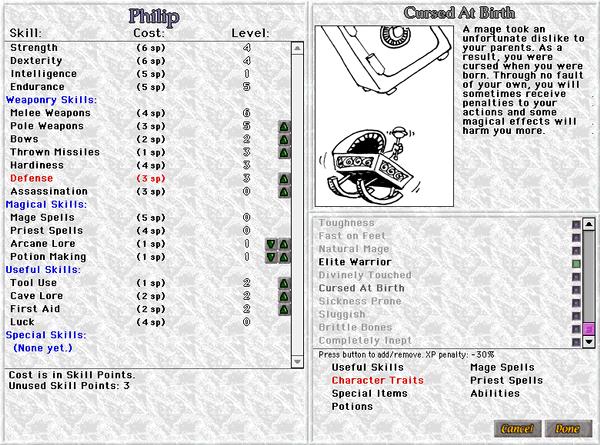
There was also a traits system. Traits are special character qualities, some positive, some negative, that affected your characters. They could make you better at spells, more vulnerable to disease, and so on. Good traits came with a penalty to experience earned. Bad traits gave you a bonus. You could have at most two traits.

And here's the awesome part. You could only pick these traits at the beginning of the game, and you couldn't change them. Major decisions that affect how you play the entire game, and you make them before you've even fought one monster. It's very hardcore and old school. By which I mean that it's mean-spirited and unnecessarily punitive.

The Better Way I Do It Now

There are still base attributes (unchanged), skills (mostly unchanged), and traits (an all-new, very long list).

When you make your characters, you can increase five skills and pick one trait from the long list. This is far, FAR less customization at the beginning than was allowed in Avernum. Because of this, many gamers will try to make a party, think I have completely dumbed down the system, and ragequit. Price of doing business.


But then, when you gain a level, a base attribute goes up by one point. It's different each level, so every four levels each attribute has gone up by one. In addition, each level you can choose one attribute to increase by one. This allows a lot of character customization while making sure all skills go up gradually so that you won't be hamstrung by completely neglecting an attribute.

Each level, you can also increase two different skills by one point. Thus, you never stop being able to shape your characters. As you get a better idea of the challenges you are facing, you can mold your characters to enable them to proceed.

Finally, every other level, you can pick one trait from the long list. The number of available choices starts out small (to keep from confusing new players) and grows dramatically as you proceed. You will eventually have a lot of traits. Some of them give simple bonuses to your spells or attacks, while others (like Backstab or Swordmage) will affect how you actually play your character.

I plan to take a lot of heat because I allow fewer choices early on, but overall you make more decisions to mold your character in the new system than in the old system, and there are more ways to customize a character. The change means that you make a larger percentage of the decisions later on. As it should be.

Of Course, There Is No Way To Win

I have often observed that people hate change. I have tried to make a more friendly system that provides more customization, but a lot of people will be angry about the loss of the old system (which has been in place for a very long time). I can totally understand this, but I still need to always strive to make things better.

Also, while the old system made it very possible to build a party that would find itself stuck and unable to proceed. Some players actually like that. To them, the challenge of avoiding that fate is part of the game, and the threat of a failed party adds excitement to the game. For them, I can only suggest playing on Torment difficulty. It will provide ample possibility of horrible failure.

But I'm very happy with the new system. I think it allows players to answer the questions the game poses when they understand what those questions truly are. And now I enter beta testing and the actual balancing of the new system. And that, of course, is when the suffering truly begins.

Tuesday, August 2, 2011

How To Drop/Create EM dbconsole of Single Instance Database

Manually recreate dbconsole 10gR2

Single Instance : $ORACLE_HOME/bin/emca -config dbcontrol db -repos create
RAC Database : $ORACLE_HOME/bin/emca -config dbcontrol db -repos create -cluster

First remove repository and files

How to drop DBConsole configuration files using EMCA (leave repository intact) ?

  •  


  • To remove DBConsole configuration files (leaving repository intact) run following EMCA command.

    <ORACLE_HOME>/bin/emca -deconfig dbcontrol db

    Enter the following information:
    Database SID: orcl
    Do you wish to continue? [yes(Y)/no(N)]:

    Note: This command will remove only the DBConsole configuration files which are under  


  • <ORACLE_HOME>/<Hostname_SID> and 


  • <ORACLE_HOME>/oc4j/j2ee/OC4J_DBConsole_<Hostname>_<SID>


  • EXAMPLE

    D:>emca -deconfig dbcontrol db

    STARTED EMCA at Aug 2, 2011 12:38:43 PM
    EM Configuration Assistant, Version 10.2.0.1.0 Production
    Copyright (c) 2003, 2005, Oracle.  All rights reserved.


    Enter the following information:
    Database SID: orcl


    Do you wish to continue? [yes(Y)/no(N)]: Y
    Aug 2, 2011 12:38:54 PM oracle.sysman.emcp.EMConfig perform
    INFO: This operation is being logged at D:\oracle\product\10.2.0\db_1\cfgtoollog
    s\emca\emca_2011-08-02_12-38-43-PM.log.
    Aug 2, 2011 12:38:56 PM oracle.sysman.emcp.EMDBPreConfig invoke
    WARNING: Database instance unavailable.
    Aug 2, 2011 12:38:56 PM oracle.sysman.emcp.util.DBControlUtil stopOMS
    INFO: Stopping Database Control (this may take a while) ...
    Aug 2, 2011 12:39:01 PM oracle.sysman.emcp.target.TargetManager cleanupAgent
    WARNING: Error initializing SQL connection. SQL operations cannot be performed
    Enterprise Manager configuration completed successfully
    FINISHED EMCA at Aug 2, 2011 12:39:02 PM

    Drop DBConsole configuration files manually
    remove both directories

  • <ORACLE_HOME>/<Hostname_SID>


  • <ORACLE_HOME>/oc4j/j2ee/OC4J_DBConsole_<Hostname>_<SID>


  • How to drop DBConsole repository objects manually ?

    DBConsole repository can be dropped manually by executing following SQL statements.


    Step 1: Drop AQ related objects in the SYSMAN schema Logon SQLPLUS as user SYS
     
    SQL> exec DBMS_AQADM.DROP_QUEUE_TABLE(queue_table=>'SYSMAN.MGMT_NOTIFY_QTABLE',force=>TRUE);

    Step 2: Drop the DB Control Repository Objects Logon SQLPLUS as user SYS or SYSTEM, and drop the sysman account and management objects:

     
    SQL> SHUTDOWN IMMEDIATE;
    SQL> STARTUP RESTRICT;
    SQL> EXEC sysman.emd_maintenance.remove_em_dbms_jobs;
    SQL> EXEC sysman.setEMUserContext('',5);
    SQL> REVOKE dba FROM sysman;
    SQL> DECLARE
    CURSOR c1 IS
    SELECT owner, synonym_name name
    FROM dba_synonyms
    WHERE table_owner = 'SYSMAN';
    BEGIN
    FOR r1 IN c1 LOOP
    IF r1.owner = 'PUBLIC' THEN
    EXECUTE IMMEDIATE 'DROP PUBLIC SYNONYM '||r1.name;
    ELSE
    EXECUTE IMMEDIATE 'DROP SYNONYM '||r1.owner||'.'||r1.name;
    END IF;
    END LOOP;
    END;
    /
    SQL> DROP USER mgmt_view CASCADE;
    SQL> DROP ROLE mgmt_user;
    SQL> DROP USER sysman CASCADE;
    SQL> ALTER SYSTEM DISABLE RESTRICTED SESSION;


    On Windows you also need to delete the DB Console service:

    Using regedit
    - run regedit
    - navigate to HKEY_LOCAL_MACHINE/SYSTEM/CurrentControlSet/Services
    - locate the OracleDBConsole<sid> entry and delete it
    Or
    On Windows XP and Windows Server 2003 you can run the following from the command line:
    CMD> sc delete <service_name>
    - where <service_name> is the DB Control service name (typically: OracleDBConsole<sid>)
    Or
    CMD> nmesrvops delete <servicename>
    - where <service_name> is the DB Control service name (typically: OracleDBConsole<sid>)
    .


    Monday, August 1, 2011

    EM Database Control -Recovering From Errors Due to CA Expiry on Oracle DB 10.2.0.4


      Purpose
         What is the Issue?
      Scope and Application
         Who is Affected?
      Enterprise Manager Database Control Configuration - Recovering From Errors Due to CA Expiry on Oracle Database 10.2.0.4 or 10.2.0.5 [Video]
         What Happens During Database Control Configuration Failure?
         Recovering from Configuration Errors on a Single Instance Database
         Recovering from Configuration Errors in an Oracle Real Application Clusters (RAC) Environment
      References


    Applies to:

    Oracle Server - Enterprise Edition - Version: 10.2.0.4 to 10.2.0.5 - Release: 10.2 to 10.2
    Oracle Database Configuration Assistant - Version: 10.2.0.4 to 10.2.0.5   [Release: 10.2 to 10.2]
    Information in this document applies to any platform.
    Enterprise Manager Database Control 10.2.0.4 and 10.2.0.5

    Purpose

    What is the Issue?

    In Enterprise Manager Database Control with Oracle Database 10.2.0.4 and 10.2.0.5, the root certificate used to secure communications via the Secure Socket Layer (SSL) protocol will expire on 31-Dec-2010 00:00:00. The certificate expiration will cause errors if you attempt to configure Database Control on or after 31-Dec-2010. Existing Database Control configurations are not impacted by this issue.

    If you plan to configure Database Control with either of these Oracle Database releases, Oracle strongly recommends that you apply Patch 8350262 to your Oracle Home installations before you configure Database Control. Configuration of Database Control is typically done when you create or upgrade Oracle Database, or if you run Enterprise Manager Configuration Assistant (EMCA) in standalone mode.

    Note the following:

    • The issue impacts configuration of Database Control with Oracle Database 10.2.0.4 and 10.2.0.5 only. It does not impact database creation or upgrade.
    • The issue does not impact existing Database Control configurations.
    • Application of Patch 8350262 does not require any database downtime

    Note: If you apply Patch 8350262 to your Oracle Home installations before you configure Database Control, you will not need to follow the recovery steps outlined in this document.

    Scope and Application

    Who is Affected?

    If you did not apply Patch 8350262 before configuring Database Control, you will encounter errors during the Database Control configuration process on or after 31-Dec-2010 under the following conditions:
    • When configuring Database Control while installing Oracle Database 10.2.0.4 or 10.2.0.5 using Database Configuration Assistant (DBCA)
    • When configuring Database Control while upgrading to Oracle Database 10.2.0.4 or 10.2.0.5 on a new or existing Oracle Home using Database Upgrade Assistant (DBUA)
    • When configuring or re-configuring Database Control for Oracle Database 10.2.0.4 or 10.2.0.5 on an existing Oracle Home using Database Configuration Assistant (DBCA) or Enterprise Manager Configuration Assistant (EMCA)

    Enterprise Manager Database Control Configuration - Recovering From Errors Due to CA Expiry on 

    Oracle Database 10.2.0.4 or 10.2.0.5 [Video] PATCH:8350262

    CREATE DBCONSOLE CERT WITH 10YEAR VALIDITY NOTE:1217493.1

    ATTENTION - Enterprise Manager Database Control 10.2.0.4 Or 10.2.0.5 - Patch Required from 31-Dec-2010 onwards

    What Happens During Database Control Configuration Failure?

    Database Configuration Assistant (DBCA) and Database Upgrade Assistant (DBUA) Errors


    Database Configuration Assistant (DBCA) and Database Upgrade Assistant (DBUA) will report the following error in the console:

    Could not complete the Enterprise Manager configuration.
    Enterprise manager configuration failed due to the following error –
    Error starting Database Control

    Enterprise Manager Configuration Assistant (EMCA) Errors

    Enterprise Manager Configuration Assistant (EMCA) will write errors similar to those below to the emca.log file:


    CONFIG: Securing Database Control completed successfully .
    Jan 2, 2011 7:22:47 PM oracle.sysman.emcp.ParamsManager getParam
    CONFIG: No value was set for the parameter ORACLE_HOSTNAME.
    Jan 2, 2011 7:22:47 PM oracle.sysman.emcp.util.DBControlUtil startOMS
    INFO: Starting Database Control (this may take a while) ...
    Jan 2, 2011 7:22:47 PM oracle.sysman.emcp.util.PlatformInterface addEnvVarToList
    CONFIG: Value for env var 'ORACLE_HOSTNAME' is '', discarding the same
    CONFIG: Returning env array from cache
    Jan 2, 2011 7:22:47 PM oracle.sysman.emcp.util.PlatformInterface executeCommand
    CONFIG: Starting execution: /myhost/bin/emctl start dbconsole
    Jan 2, 2011 7:27:26 PM oracle.sysman.emcp.util.PlatformInterface executeCommand
    CONFIG: Exit value of 1
    Jan 2, 2011 7:27:26 PM oracle.sysman.emcp.util.PlatformInterface executeCommand
    CONFIG: Oracle Enterprise Manager 10g Database Control Release 10.2.0.4.0
    Copyright (c) 1996, 2007 Oracle Corporation. All rights reserved.
    https://myhost:5501/em/console/aboutApplication
    Starting Oracle Enterprise Manager 10g Database Control
    ............................................................................................. failed.
    ------------------------------------------------------------------
    Logs are generated in directory /myhost/sysman/log
    Jan 2, 2011 7:27:26 PM oracle.sysman.emcp.util.PlatformInterface executeCommand
    WARNING: Error executing /myhost/bin/emctl start dbconsole
    Jan 2, 2011 7:27:26 PM oracle.sysman.emcp.EMConfig perform
    SEVERE: Error starting Database Control
    Refer to the log file at /myhost/dbua/d4/upgrade/emConfig.log for more details.
    Jan 2, 2011 7:27:26 PM oracle.sysman.emcp.EMConfig perform
    CONFIG: Stack Trace:
    oracle.sysman.emcp.exception.EMConfigException: Error starting Database Control
    at oracle.sysman.emcp.EMDBPostConfig.performUpgrade(EMDBPostConfig.java:763)
    at oracle.sysman.emcp.EMDBPostConfig.invoke(EMDBPostConfig.java:232)
    at oracle.sysman.emcp.EMDBPostConfig.invoke(EMDBPostConfig.java:193)
    at oracle.sysman.emcp.EMConfig.perform(EMConfig.java:184)
    at oracle.sysman.assistants.util.em.EMConfiguration.run(EMConfiguration.java:436)
    at oracle.sysman.assistants.util.em.EMConfigStep.executeImpl(EMConfigStep.java:140)
    at oracle.sysman.assistants.util.step.BasicStep.execute(BasicStep.java:210)
    at oracle.sysman.assistants.util.step.BasicStep.callStep(BasicStep.java:251)
    at oracle.sysman.assistants.dbma.backend.EMConfigStep.executeStepImpl(EMConfigStep.java:104)
    at oracle.sysman.assistants.dbma.backend.SummarizableStep.executeImpl(SummarizableStep.java:175)
    at oracle.sysman.assistants.util.step.BasicStep.execute(BasicStep.java:210)
    at oracle.sysman.assistants.util.step.Step.execute(Step.java:140)
    at oracle.sysman.assistants.util.step.StepContext$ModeRunner.run(StepContext.java:2488)
    at java.lang.Thread.run(Thread.java:534)

    The EMCA console will display output similar to the following:

    aime@myhost09 db_1]$ bin/emca -config dbcontrol db -repos recreate -cluster
    STARTED EMCA at Jan 11, 2011 4:11:01 PM
    EM Configuration Assistant, Version 10.2.0.1.0 Production
    Copyright (c) 2003, 2005, Oracle. All rights reserved.

    Enter the following information:
    Database unique name: catest
    Database Control is already configured for the database catest
    You have chosen to configure Database Control for managing the database catest

    This will remove the existing configuration and the default settings and perform a fresh configuration
    Do you wish to continue? [yes(Y)/no(N)]: Y
    Listener port number: 1521
    Cluster name: mycluster
    Password for SYS user:
    Password for DBSNMP user:
    Password for SYSMAN user:
    Email address for notifications (optional):
    Outgoing Mail (SMTP) server for notifications (optional):

    ........

    Jan 11, 2011 4:18:05 PM oracle.sysman.emcp.util.DBControlUtil secureDBConsole
    INFO: Securing Database Control (this may take a while) ...
    Jan 11, 2011 4:19:31 PM oracle.sysman.emcp.util.DBControlUtil startOMS
    INFO: Starting Database Control (this may take a while) ...
    Jan 11, 2011 4:28:38 PM oracle.sysman.emcp.EMConfig perform
    SEVERE: Error starting Database Control
    Refer to the log file at /myhost/oracle/product/10.2.0/db_1/cfgtoollogs/emca/catest/emca_2011-01-11_
    04-11-01-PM.log for more details.
    Could not complete the configuration. Refer to the log file at /myhost/oracle/product/10.2.0/db_
    1/cfgtoollogs/emca/catest/emca_2011-01-11_04-11-01-PM.log for more details.

    Checking the ORACLE_HOME\<hostname>_<SID>\sysman\log\emagent.trc, one can see also:

    2011-01-09 09:36:56 Thread-51125136 ERROR pingManager: nmepm_pingReposURL: Cannot connect to https://myhost:1158/em/upload/: retStatus=-1
    2011-01-09 09:36:56 Thread-51125136 ERROR ssl: Open wallet failed, ret = 28750
    2011-01-09 09:36:56 Thread-51125136 ERROR ssl: nmehlenv_openWallet failed
    2011-01-09 09:36:56 Thread-51125136 ERROR http: 15: Unable to initialize ssl connection with server, aborting connection attempt

    Also, the following errors has been reported in some cases:

    2011-01-06 18:50:54 Thread-3393 ERROR ssl: nzos_Initialize failed, ret = 43061
    2011-01-06 18:50:54 Thread-3393 ERROR http: 14: Unable to initialize ssl connection with server, aborting connection attempt
    2011-01-06 18:50:54 Thread-3393 ERROR pingManager: nmepm_pingReposURL: Cannot connect tohttps://myhost:1158/em/upload/:retStatus=-1

    At the end of the database installation on non-Windows platforms, both Database Control and the Management Agent will be up and running, even though the status of both components will be shown as not running, because EMCTL will be unable to connect to the dbconsole process. In addition, Database Control will fail to connect to the Agent.

    Note for Windows Platform Only:

    On Windows, the dbconsole process will be stopped after the failed configuration attempt. Note that the tool used to perform Database Control configuration (DBUA, DBCA or EMCA) will also wait for 15 minutes for Database Control to start, then time out.

    The output of the "emctl status dbconsole" command incorrectly returns the status of Database Control, as shown below (note that this command may take a while to complete, especially in a RAC environment) :

    $ ./emctl status dbconsole
    Oracle Enterprise Manager 10g Database Control Release 10.2.0.1.0
    Copyright (c) 1996, 2005 Oracle Corporation. All rights reserved.
    https://myhost:1158/em/console/aboutApplication
    Oracle Enterprise Manager 10g is not running.

    The output of the "emctl status agent" command incorrectly returns the status of the Agent, as shown
    below:

    $ ./emctl status agent
    Oracle Enterprise Manager 10g Database Control Release 10.2.0.1.0
    Copyright (c) 1996, 2005 Oracle Corporation. All rights reserved.
    ---------------------------------------------------------------
    Agent is Not Running

    Recovering from Configuration Errors on a Single Instance Database

    1. Ignore any errors and continue with the installation or upgrade. The database will be created without errors.

    2. Apply Patch 8350262 to your Oracle Home installation using OPatch.

    NOTE:   The database instance and the listener DO NOT have to be stopped for applying this patch, but ensure that all java processes sourced from the Oracle Home being patached are stopped in this case (i.e., all Oracle Home-related java.exe on Windows, for instance).

    opatch apply

    Invoking OPatch 10.2.0.4.2

    Oracle Interim Patch Installer version 10.2.0.4.2
    Copyright (c) 2007, Oracle Corporation. All rights reserved.

    Oracle Home : /myhost
    Central Inventory : /scratch/pchebrol/oraInventory
    from : /etc/oraInst.loc
    OPatch version : 10.2.0.4.2
    OUI version : 10.2.0.4.0
    OUI location : /myhost/oui
    Log file location : /myhost/cfgtoollogs/opatch/opatch2011-01-02_11-00-00AM.log

    ApplySession applying interim patch '8350262' to OH '/myhost'

    Running prerequisite checks...

    OPatch detected non-cluster Oracle Home from the inventory and will patch the local system only.

    Backing up files and inventory (not for auto-rollback) for the Oracle Home
    Backing up files affected by the patch '8350262' for restore. This might take a while...
    Backing up files affected by the patch '8350262' for rollback. This might take a while...

    Patching component oracle.sysman.agent.core, 10.2.0.4.0a...
    Updating jar file "/myhost/sysman/jlib/emCORE.jar" with
    "/sysman/jlib/emCORE.jar/oracle/sysman/eml/sec/fsc/FSWalletUtil.class"
    Updating jar file "/myhost/sysman/jlib/emCORE.jar" with
    "/sysman/jlib/emCORE.jar/oracle/sysman/eml/sec/rep/RepWalletUtil.class"
    Updating jar file "/myhost/sysman/jlib/emCORE.jar" with
    "/sysman/jlib/emCORE.jar/oracle/sysman/eml/sec/util/RootCert.class"
    Updating jar file "/myhost/sysman/jlib/emCORE.jar" with
    "/sysman/jlib/emCORE.jar/oracle/sysman/eml/sec/util/SecConstants.class"
    Updating jar file "/myhost/sysman/jlib/emd_java.jar" with "/sysman/jlib/emd_
    java.jar/oracle/sysman/eml/sec/fsc/FSWalletUtil.class"
    Updating jar file "/myhost/sysman/jlib/emd_java.jar" with "/sysman/jlib/emd_
    java.jar/oracle/sysman/eml/sec/rep/RepWalletUtil.class"
    Updating jar file "/myhost/sysman/jlib/emd_java.jar" with "/sysman/jlib/emd_
    java.jar/oracle/sysman/eml/sec/util/RootCert.class"
    Updating jar file "/myhost/sysman/jlib/emd_java.jar" with "/sysman/jlib/emd_
    java.jar/oracle/sysman/eml/sec/util/SecConstants.class"
    ApplySession adding interim patch '8350262' to inventory

    Verifying the update...
    Inventory check OK: Patch ID 8350262 is registered in Oracle Home inventory with proper meta-data.
    Files check OK: Files from Patch ID 8350262 are present in Oracle Home.

    OPatch succeeded.

    3. After applying the patch, force stop the Database Control (dbconsole) process using the killDBConsole script bundled with the patch. Note that the dbconsole process cannot be stopped using the emctl stop dbconsole command, as EMCTL is unable to connect to the process.
    To execute the killDBConsole script:
    • Set the ORACLE_HOME and ORACLE_SID environment variables.
    • Execute <PATCH_HOME>/killDBConsole.
    Note for Windows Platform Only:

    It is not necessary to force stop the dbconsole process on the Windows platform, because the process will already be in a stopped state at the end of the failed configuration attempt.

    The killDBConsole script output is shown below:
    $ <PATCH_HOME>/killDBConsole
    ORACLE_HOME=/myhost/db_1
    ORACLE_SID=caem31
    State directory = /myhost/db_1/staxd10_caem31
    WatchDog PID = 802932
    DBconsole PID = 577716
    EMAgent PID = 512156
    Killing WatchDog (pid=802932) ...
    Successfully killed process 802932
    Killing DBConsole (pid=577716) ...
    Successfully killed process 577716
    Killing EMAgent (pid=512156) ...
    Successfully killed process 512156

    4. Re-secure Database Control with the following command:

    <ORACLE_HOME>/bin/emctl secure dbconsole -reset

    You will be prompted twice to confirm that the Root key must be overwritten. In both cases, enter upper-case "Y" as the response. Any other response (including lower-case "y") will cause the command to terminate without completing. If this happens, the command can be re-invoked.

    $ ./emctl secure dbconsole -reset
    Oracle Enterprise Manager 10g Database Control Release 10.2.0.4.0
    Copyright (c) 1996, 2007 Oracle Corporation. All rights reserved.
    https://myhost:5501/em/console/aboutApplication
    Enter Enterprise Manager Root Password :
    DBCONSOLE already stopped... Done.
    Agent is already stopped... Done.
    Securing dbconsole... Started.
    Checking Repository... Done.
    Checking Em Key... Done.
    Checking Repository for an existing Enterprise Manager Root Key...
    WARNING! An Enterprise Manager Root Key already exists in
    the Repository. This operation will replace your Enterprise
    Manager Root Key.
    All existing Agents that use HTTPS will need to be
    reconfigured if you proceed. Do you wish to continue and
    overwrite your Root Key
    (Y/N) ?
    Y
    Are you sure ? Reset of the Enterprise Manager Root Key
    will mean that you will need to reconfigure each Agent
    that is associated with this OMS before they will be
    able to upload any data to it. Monitoring of Targets
    associated with these Agents will be unavailable until
    after they are reconfigured.
    (Y/N) ?
    Y
    Generating Enterprise Manager Root Key (this takes a minute)... Done.Fetching Root Certificate from
    the Repository... Done.
    Updating HTTPS port in emoms.properties file... Done.
    Generating Java Keystore... Done.
    Securing OMS ... Done.
    Generating Oracle Wallet Password for Agent.... Done.
    Generating wallet for Agent ... Done.
    Copying the wallet for agent use... Done.
    Storing agent key in repository... Done.
    Storing agent key for agent ... Done.
    Configuring Agent...
    Configuring Agent for HTTPS in DBCONSOLE mode... Done.
    EMD_URL set in /myhost/myhost/sysman/config/emd.properties
    Done.
    Configuring Key store.. Done.
    Securing dbconsole... Sucessful.

    5. Re-start Database Control with the following command:

    <ORACLE_HOME>/bin/emctl start dbconsole

    Recovering from Configuration Errors in an Oracle Real Application Clusters (RAC) Environment

    1. Ignore any errors and continue with the upgrade, so that the database is upgraded without errors.

    2. Apply Patch 8350262 to your Oracle Home installation. Note that the OPatch utility will apply the patch to all nodes in the cluster, as shown below:

    ../OPatch/opatch apply
    Invoking OPatch 10.2.0.4.2

    Oracle Interim Patch Installer version 10.2.0.4.2
    Copyright (c) 2007, Oracle Corporation. All rights reserved.

    Oracle Home : /myhost/oracle/product/10.2.0/db_1
    Central Inventory : /myhost/app/oraInventory
    from : /etc/oraInst.loc
    OPatch version : 10.2.0.4.2
    OUI version : 10.2.0.4.0
    OUI location : /myhost/oracle/product/10.2.0/db_1/oui
    Log file location : /myhost/oracle/product/10.2.0/db_1/cfgtoollogs/opatch/opatch2011-01-01_
    21-30-27PM.log

    ApplySession applying interim patch '8350262' to OH '/myhost/oracle/product/10.2.0/db_1'

    Running prerequisite checks...

    OPatch detected the node list and the local node from the inventory. OPatch will patch the local
    system then propagate the patch to the remote nodes.

    Backing up files and inventory (not for auto-rollback) for the Oracle Home
    Backing up files affected by the patch '8350262' for restore. This might take a while...
    Backing up files affected by the patch '8350262' for rollback. This might take a while...

    Patching component oracle.sysman.agent.core, 10.2.0.4.0a...
    Updating jar file "/myhost/oracle/product/10.2.0/db_1/sysman/jlib/emCORE.jar" with
    "/sysman/jlib/emCORE.jar/oracle/sysman/eml/sec/fsc/FSWalletUtil.class"
    Updating jar file "/myhost/oracle/product/10.2.0/db_1/sysman/jlib/emCORE.jar" with
    "/sysman/jlib/emCORE.jar/oracle/sysman/eml/sec/rep/RepWalletUtil.class"
    Updating jar file "/myhost/oracle/product/10.2.0/db_1/sysman/jlib/emCORE.jar" with
    "/sysman/jlib/emCORE.jar/oracle/sysman/eml/sec/util/RootCert.class"
    Updating jar file "/myhost/oracle/product/10.2.0/db_1/sysman/jlib/emCORE.jar" with
    "/sysman/jlib/emCORE.jar/oracle/sysman/eml/sec/util/SecConstants.class"
    Updating jar file "/myhost/oracle/product/10.2.0/db_1/sysman/jlib/emd_java.jar" with
    "/sysman/jlib/emd_java.jar/oracle/sysman/eml/sec/fsc/FSWalletUtil.class"
    Updating jar file "/myhost/oracle/product/10.2.0/db_1/sysman/jlib/emd_java.jar" with
    "/sysman/jlib/emd_java.jar/oracle/sysman/eml/sec/rep/RepWalletUtil.class"
    Updating jar file "/myhost/oracle/product/10.2.0/db_1/sysman/jlib/emd_java.jar" with
    "/sysman/jlib/emd_java.jar/oracle/sysman/eml/sec/util/RootCert.class"
    Updating jar file "/myhost/oracle/product/10.2.0/db_1/sysman/jlib/emd_java.jar" with
    "/sysman/jlib/emd_java.jar/oracle/sysman/eml/sec/util/SecConstants.class"
    ApplySession adding interim patch '8350262' to inventory

    Verifying the update...
    Inventory check OK: Patch ID 8350262 is registered in Oracle Home inventory with proper meta-data.
    Files check OK: Files from Patch ID 8350262 are present in Oracle Home.

    Patching in rolling mode.

    Updating nodes 'myhost'
    Apply-related files are:
    FP = :/myhost/oracle/product/10.2.0/db_1/.patch_storage/8350262_Sep_14_2010_04_59_44/rac/copy_
    files.txt"
    DP = "/myhost/oracle/product/10.2.0/db_1/.patch_storage/8350262_Sep_14_2010_04_59_44/rac/copy_
    dirs.txt"
    MP = "/myhost/oracle/product/10.2.0/db_1/.patch_storage/8350262_Sep_14_2010_04_59_44/rac/make_
    cmds.txt"
    RC = "/myhost/oracle/product/10.2.0/db_1/.patch_storage/8350262_Sep_14_2010_04_59_44/rac/remote_
    cmds.txt"

    Instantiating the file "/myhost/oracle/product/10.2.0/db_1/.patch_storage/8350262_Sep_14_2010_04_59_
    44/rac/copy_files.txt.instantiated" by replacing $ORACLE_HOME in "/myhost/oracle/product/10.2.0/db_
    1/.patch_storage/8350262_Sep_14_2010_04_59_44/rac/copy_files.txt" with actual path.
    Propagating files to remote nodes...
    Instantiating the file "/myhost/oracle/product/10.2.0/db_1/.patch_storage/8350262_Sep_14_2010_04_59_
    44/rac/copy_dirs.txt.instantiated" by replacing $ORACLE_HOME in "/myhost/oracle/product/10.2.0/db_
    1/.patch_storage/8350262_Sep_14_2010_04_59_44/rac/copy_dirs.txt" with actual path.
    Propagating directories to remote nodes...

    OPatch succeeded.

    3. After applying the patch, force stop the Database Control (dbconsole) process by executing the
    killDBConsole script bundled with the patch on each node in the cluster. Note that the dbconsole
    process cannot be stopped using the emctl stop dbconsole command, as EMCTL is unable to connect
    to the process.

    To execute the killDBConsole script:
    • Set the ORACLE_HOME and ORACLE_SID environment variables.
    • Execute <PATCH_HOME>/killDBConsole
    Note for Windows Platform Only:
    It is not necessary to force stop the dbconsole process on the Windows platform, because the process will

    already be in a stopped state at the end of the failed configuration attempt.

    The killDBConsole script output is shown below:

    $ <PATCH_HOME>/killDBConsole
    ORACLE_HOME=/myhost/catest/db_1
    ORACLE_SID=caem31
    State directory = /myhost/catest/db_1/staxd10_caem31
    WatchDog PID = 802932
    DBconsole PID = 577716
    EMAgent PID = 512156
    Killing WatchDog (pid=802932) ...
    Successfully killed process 802932
    Killing DBConsole (pid=577716) ...
    Successfully killed process 577716
    Killing EMAgent (pid=512156) ...
    Successfully killed process 512156


    NOTE:   The following is a REQUIRED STEP!
    4. Re-secure Database Control on the first cluster node with the following command:

    <ORACLE_HOME>/bin/emctl secure dbconsole -reset

    You will be prompted twice to confirm that the Root key must be overwritten. In both cases, enter upper-case "Y" as the response. Any other response (including lower-case "y") will cause the command to terminate without completing. If this happens, the command can be re-invoked.

    $ ./emctl secure dbconsole -reset
    Oracle Enterprise Manager 10g Database Control Release 10.2.0.4.0
    Copyright (c) 1996, 2007 Oracle Corporation. All rights reserved.
    https://myhost:5501/em/console/aboutApplication
    Enter Enterprise Manager Root Password :
    DBCONSOLE already stopped... Done.
    Agent is already stopped... Done.
    Securing dbconsole... Started.
    Checking Repository... Done.
    Checking Em Key... Done.
    Checking Repository for an existing Enterprise Manager Root Key...
    WARNING! An Enterprise Manager Root Key already exists in
    the Repository. This operation will replace your Enterprise
    Manager Root Key.
    All existing Agents that use HTTPS will need to be
    reconfigured if you proceed. Do you wish to continue and
    overwrite your Root Key
    (Y/N) ?
    Y
    Are you sure ? Reset of the Enterprise Manager Root Key
    will mean that you will need to reconfigure each Agent
    that is associated with this OMS before they will be
    able to upload any data to it. Monitoring of Targets
    associated with these Agents will be unavailable until
    after they are reconfigured.
    (Y/N) ?
    Y
    Generating Enterprise Manager Root Key (this takes a minute)... Done.Fetching Root Certificate from
    the Repository... Done.
    Updating HTTPS port in emoms.properties file... Done.
    Generating Java Keystore... Done.
    Securing OMS ... Done.
    Generating Oracle Wallet Password for Agent.... Done.
    Generating wallet for Agent ... Done.
    Copying the wallet for agent use... Done.
    Storing agent key in repository... Done.
    Storing agent key for agent ... Done.
    Configuring Agent...
    Configuring Agent for HTTPS in DBCONSOLE mode... Done.
    EMD_URL set in /myhost/sysman/config/emd.properties
    Done.
    Configuring Key store.. Done.
    Securing dbconsole... Sucessful.


    5. Re-secure Database Control on the remaining cluster nodes with the following command. Note that the -reset switch is not included with this command:
    <ORACLE_HOME>/bin/emctl secure dbconsole

    (Note:   the "Enter Enterprise Manager Root Password :" value is that for sysman)

    [myhost bin]$ ./emctl secure dbconsole
    Oracle Enterprise Manager 10g Database Control Release 10.2.0.4.0
    Copyright (c) 1996, 2007 Oracle Corporation. All rights reserved.
    https://myhost:1158/em/console/aboutApplication
    Enter Enterprise Manager Root password :
    Enter a Hostname for this OMS : myhost
    DBCONSOLE already stopped... Done.
    Agent is already stopped... Done.
    Securing dbconsole... Started.
    Checking Repository... Done.
    Checking Em Key... Done.
    Checking Repository for an existing Enterprise Manager Root Key... Done.
    Fetching Root Certificate from the Repository... Done.
    Updating HTTPS port in emoms.properties file... Done.
    Generating Java Keystore... Done.
    Securing OMS ... Done.
    Generating Oracle Wallet Password for Agent.... Done.
    Generating wallet for Agent ... Done.
    Copying the wallet for agent use... Done.
    Storing agent key in repository... Done.
    Storing agent key for agent ... Done.
    Configuring Agent...
    Configuring Agent for HTTPS in DBCONSOLE mode... Done.
    EMD_URL set in /myhost/oracle/product/10.2.0/db_1/myhost/sysman/c
    onfig/emd.properties
    Done.
    Configuring Key store.. Done.
    Securing dbconsole... Sucessful.

    6. Re-start Database Control by executing the following command on each node in the cluster:

    <ORACLE_HOME>/bin/emctl start dbconsol