Showing posts with label avernum. Show all posts

Monday, April 30, 2012

Avernum Out For Windows, For What It's Worth.


A few weeks ago, Spiderweb Software finally released our newest role-playing game, Avernum: Escape From the Pit, for Windows. It's also out on Steam.

It's OK if you didn't notice, as a far higher profile indie RPG, Legend of Grimrock, came out the same day. It's a lot of fun and I'm almost done with it. I'll blog about it soon.

I've taken this long to blog about it (or anything) because work stress, increasing age, and family health issues have given me a persistent case of burnout. Burnout is an interesting issue. I'll blog about it soon.

Avernum: Escape From the Pit is doing well. It is old material. It's a rewrite of Avernum, which is itself a rewrite of Exile: Escape From the Pit. And yet, thanks to iTunes and Steam, it has already, in only a few months, earned as much as either of those titles earned in years and years. The revolutionary effect of Steam and iTunes on people trying to have my career simply cannot be understated. I'll blog about it soon.

Since it's a rewrite, it hasn't gotten as many reviews, which is fair. GameBanshee wrote a tough, fair, generally positive review which makes me want to write some interesting things about video games and art. No, I'm kidding. Writing about video games and art is never interesting. Still. I'll blog about it soon.

I've also been playing Mass Effect 3, when I can work up the energy. I'm not feeling it the way I felt Mass Effect 1 and 2, but I'm sure I can come up with some interesting things to say about it. I won't bother to write an actual review, as you've already finished it and made a YouTube video about how angry the ending made you. I'll blog about it soon.

Finally, Community has been having an amazing season. I won't blog about it, as Community fans are almost as tiresomely aggressive in their evangelism as The Wire fans and bronies. Still. If you watch it on Hulu before it gets cancelled (which should happen ... ... NOW), you can be ahead of the nerd-culture curve.

Monday, April 9, 2012

The iPad. Changing Fast and Faster.


I'll get the PR puffery out of the way early. We released our newest game, Avernum: Escape From the Pit HD, on the iPad last week. There are almost no old-school RPGs on the platform, and this is a good one.

OK. Done.

I wanted to talk a little about how much changed on the iPad (and the iPhone) in the mere eight months since we released our first game for it, Avadon: The Black Fortress HD, in June, 2011. It really fascinates me.

First, everything that was crazy before is more crazy. iPad sales have taken off even more than before, and competing tablets are being crushed by its awesomeness. (Yes, I think that the iPad is the superior tablet computer. Please feel free to pillory me in comments.) My previous game, Avadon HD, is selling far better than it did 4 or 5 months ago, just from increased popularity of the iPad.

Second, developers have noticed. The flood of new games for iPad and iPhone has not slowed at all. In fact, it feels like it's increased. I don't have figures to back this up, only my gut feeling. If you have a link to hard figures, please let me know in comments and I'll add it to the article. There are dozens of new games every day, and your blessed placement at the top of the New Releases list won't last long. At all.

Because of this, even though I think I've done a far better job marketing Avernum HD and creating its store page than Avadon HD, it is selling far worse. Avadon HD was the best-selling RPG for several days. Avernum HD got to #2 very briefly and then immediately plummeted to #18. It's not THAT worse a game, but the flood of competitors cannot be resisted by my cute, niche little product.

Do not feel sorry for me. It is still, by any reasonable human standard, makin' us good money. But it's really rough out there. I am strongly considering posting detailed sales figures in a week or three, just to let people see what the money end of iPad development is like.

Third, free-to-play is where the money is.

I just looked at the RPG section of iTunes. As of 3:56 PM, Pacific time, April 9, 2012, the #1, #2, and #3 games on the Paid Apps list are at #25, #27, and #6 on the Grossing list. (The #3 game is $6.99, which is why its grosses are so high.) The #18 sales rank for Avernum HD nets it #46 most grossing. Freemium games kick ass.

This is a relatively recent change. In June, when Avadon HD was #1 or #2 on Paid Apps, this resulted in #3-4 on Top Grossing. I never made #1 Grossing, but I came close. Now DragonVale rules the world.

This makes me feel obsolete. I should write a freemium RPG where you can pay real money to get a +5 Paladin Sword of Awesomeness or whatever. But I just can't bring myself to do it. It's ironic. When I started, I was one of the young turks challenging the old order with shareware by giving part of my game away for free. Now I am one of the old, cranky reptiles being pushed aside by an awesome marketing angle I'm just too old and inflexible to take advantage of.

I love developing for the iPad. I love the device. It is, to quote an imaginary guy in a story Mike Daisey made up, "a kind of magic." And, since I'm the only person writing my sort of game for the platform (which is weird), I foresee reasonable earnings from it for me for quite a while. Not everone with an iPad wants a game where you spend 99 cents to buy a hat for your dragon.

But it's the sexiest, moneyest, most cutthroat competitive market out there. I can scrape out some dollars because I have an established fanbase. If I was just starting out, I would be terrified of making my way in iTunes, and rightly so.

Thursday, December 15, 2011

Avernum: Escape From the Pit Is Out


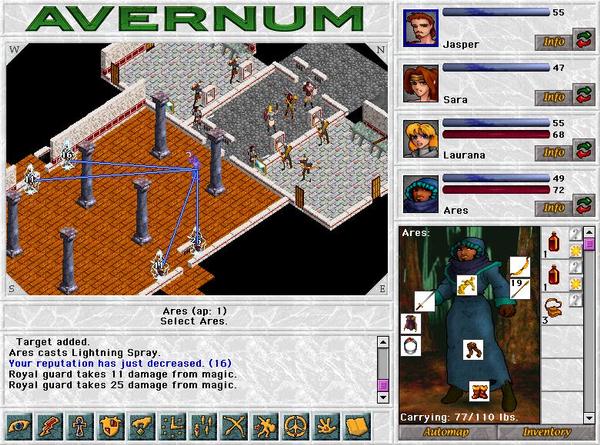
We have released our newest game, Avernum: Escape From the Pit, for the Macintosh. As I have written before, it is a ground-up rewrite of one of our earlier games that desperately needed it. We've tried to put a lot of cool new graphics, design, and polish into it. A big demo is available, and the Windows and iPad versions should be out in April.

This is a rewrite of the first game I ever wrote for money, Exile: Escape From the Pit, which first came out in January of 1995. It has been fascinating to go back to my first full-length design. I'd forgotten how weird and silly my work could get.

A few examples:

Huge, Sprawling World.

Skyrim has provided a fresh reminder of how much people love a huge, sprawling world full of details, cul-de-sacs, and side quests to get lost in. When I started out, I made games like that. Avernum is really, really big. It's possible to wander out into the wilds, get lost, and be eternally distracted by all the stuff you can do and dungeons you can explore. I was heavily inspired by the early Might and Magic games, some of the first games that really tried to overwhelm you with a huge world.

I love games like this. However, writing them is difficult for the obvious reason: A huge world takes a lot of work and a lot of energy. I'm old now, and I don't have the limitless drive I used to. I tend now to write smaller, more focused games. Less terrain to explore, but with a more intricate story.

Three Game-Winning Quests.

I am constantly accused of never innovating, and this vexes me. I have worked hard to try new things in my RPGs and stretch the genre, and I've been doing this from day one.

Example: Avernum doesn't have one storyline. It has three. The game has three long, arcing, game-winning quests, each of them almost entirely separate from each other. It is possible to achieve one of them, say escaping the underworld, be told you have won, pat yourself on the back, and never realize that the game still has two epic storylines remaining.

They aren't three different endings. They are three different games.

I did two games this way, and I've never seen another RPG that does the same thing. I eventually let it go to focus on more detailed single stories, but I still think it was a really cool idea.

Odd Humor.

In my spare time, I have had some success as a writer of humor. My games have always had funny elements, some more than others. Avernum contains some bits that are so weird and off the wall that I could never see myself doing now. I don't want to give precise examples, but if you play the game for more than a little you'll start to see what I mean.

Years Pass. Nothing You Can Do About it.

Since 1995, my work has gotten a lot tighter, more controlled, and generally less eccentric. This has been both good and bad. It's also unavoidable. I'm older and more experienced now, and that sort of fresh, unfocused enthusiasm is just not available to me anymore. I still write good games (or, at least, games that sell), but my changing tastes and increasing age have made me unable to do some things and more able to do certain new things.

For example, if you tried Avadon: The Black Fortress and didn't like it, I'm sorry. That is the sort of game I write now. This will change. Five years from now, I'll do something entirely different. (I really, really want to return to open-ended non-linear games at least once before I retire.) But for now, that's it. If you hate my new games, then there is nothing I can do about that.

But, if you don't like the new stuff, I suggest trying Avernum. It's old-school, and it's really neat. I hope you like it.

(And I'll post a link to this article in April when the versions for the other platforms come out.)

Wednesday, December 7, 2011

My Two Gaming Pet Peeves For the Day

Our newest game, Avernum: Escape From the Pit, has reached Release Candidate status. This means that we've made a version that seems complete and ready to sell, and we are touching it as little as possible while beta testers spend one more week trying to break it.

This means that I have a very, very important job: Doing nothing. Don't touch the app. Hands off. Anything I change has a chance of breaking something. So I'm spending this week catching up on my game-playing.

(I also made a really spiffy trailer for Avernum. Turns out, there's this site called YouTube. Who knew?)

This has given me a precious chance to find new pet peeves to complain about. And isn't that what blogs are for?

I Need To Drop Three Pounds Of Gloves So That I Can Walk Again

Of course, like everyone else in the world, our house has Skyrim-fever. As you may have heard, it's a good game.

But, like all RPGs Bethesda makes, you spend sooooo much time sorting through items. Looting the dungeons takes ten times longer than killing the monsters within. And you can only carry so many pounds of treasure. So every item you find requires tiresome "Is this hide shield worth enough money to justify the weight. OK. It weighs eight pounds and is worth 20 coins, or 2.5 coins per pound, so that is an efficient piece of treasure to pick up and ... AHHHH. MY BRAINS!!!!!" And then you pick up one suit of armor too many and you have to drop two pounds of stuff so you go through your pack to find something top drop and ...

Does anyone ever find this fun?

This is one of those things that gets hardcore gamerz mad at me, but screw realism. In my newest games, I give the player a Junk Bag. You can put infinite items in it, their weight isn't counted, and, when you reach a store, you can push a button to sell everything in it.

This is great for people who find even the awesome Dog Takes Your Stuff Back To Town To Sell It system in Torchlight too taxing.

It's the opposite of realism, and I really don't care. When I design a game, the first thing I do is decide what I want the player to spend most of his/her time doing. Hopefully, that part is where the fun is. The second thing I do is minimize time spent doing absolutely everything else.

If I can keep even one player from spending a hour picking through his or her backpack and trying to shed those three extra pounds, I have done my good work as a citizen of the Earth.

I Did Those Jumps In 61 Seconds Instead Of 59, So I Should Totally Be Punished.

In any game with a lot of jumping on platforms, it seems like a legal requirement that there has to be at least one room with a timed sequence. You're at the bottom of some shaft with sheer walls and a tunnel at the top. You push a button. Ledges slide out of the walls. And then you hear that accursed, stress-inducing ticking that lets you know that you have to get to the top quickly, or not at all.

"Tick. Tick. Tick. TICK. TICK. TICK. TICKTICKTICKTICKTICK. [Sound of ledges sliding back into walls.] [Sound of you falling to earth, swearing all the way.]"

Is there anyone, anywhere, who pushes that button, hears the telltale ticking sound, and thinks, "This is so AWESOME!"

This isn't fun. Here is why. Gaining a heroic skill (Fighting. Leaping.) is fun. Using that skill is fun. Perfecting a skill is far less fun. Repeating a series of jumps until you can do them perfectly is even less fun than that.

There. I Feel Better.

Very therapeutic. Now I can finish my game in peace.

Also, I was going to write about how every shooter now has you go down one long corridor with no branches (or alternate paths to victory, or variety), but this design trend is contemptible enough to deserve its own post. I just need time for my blood to get more angry.

Wednesday, August 3, 2011

Don't Ask Questions Until the Player Can Answer

When I started writing fantasy role-playing games for a living, I did a lot of dumb things. Since then, it's been a painfully slow process figuring out how to be less dumb. Every time I start a new game, there is a point where I go, "Wait. Why don't I do this thing this new way? In fact, why haven't I always done it that way?" And then I slap my forehead. Hopefully, it hurts.

One of my new, hard-earned rules of design has to do with training your characters. And, since it seems like every game and its cousin has some sort of level-gaining and stat-building these days, I think the rule is getting more relevant every day:

The number of decisions you have to make to build your character should be proportional to the amount of time you've spent playing the game. The more you play, the more you should decide.

Or, to put it another way ...

Whenever you make a decision about your character at the very beginning of the game, you are answering a question that hasn't even been asked yet.


So design wonks, get ready. Here is an example from my game Avernum, released in 1999. I will compare it to the rewritten version, Avernum: Escape From the Pit, out later this year. (And this will also double as a little taste of a preview of the new game, for those who care.)

The Bad Way I Did It Before

Avernum is an old school role-playing game. There are a lot of skills you can train to make your character stronger. There are the base attributes (Strength, Intelligence, Dexterity, Endurance) and regular skills (Swords, Spells, Lore, etc). You start out with a bunch of skill points, and you get more with each level. You should spend these on skills.


You start out with a ton of skill points, so that you can majorly customize your character from the beginning. You can use skill points to increase base attributes or regular skills, but the base attributes are expensive. However, it could break the system if a player put a huge amount of skill points in certain skills. To limit this, I made increasing a skill cost more skill points the higher you trained it. At high levels, you might have to save up for two or three levels to get enough skill points to raise a major skill one point.

Think about this. It's a system where the more you play and learn about the challenges facing you, the less you can do to customize your characters. You have to make most of the big changes at low level, when skills are cheap. Worse, it was necessary to increase the base attributes to survive (especially Endurance, which increases health), but they were so expensive that doing so required careful planning. As a result of this mess, many players had problems with getting halfway through the game and finding that they were not strong enough to proceed. These players got angry at me, and justifiably so.

There was also a traits system. Traits are special character qualities, some positive, some negative, that affected your characters. They could make you better at spells, more vulnerable to disease, and so on. Good traits came with a penalty to experience earned. Bad traits gave you a bonus. You could have at most two traits.

And here's the awesome part. You could only pick these traits at the beginning of the game, and you couldn't change them. Major decisions that affect how you play the entire game, and you make them before you've even fought one monster. It's very hardcore and old school. By which I mean that it's mean-spirited and unnecessarily punitive.

The Better Way I Do It Now

There are still base attributes (unchanged), skills (mostly unchanged), and traits (an all-new, very long list).

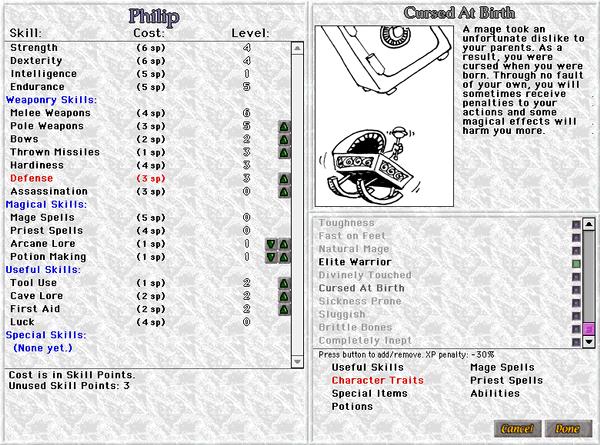
When you make your characters, you can increase five skills and pick one trait from the long list. This is far, FAR less customization at the beginning than was allowed in Avernum. Because of this, many gamers will try to make a party, think I have completely dumbed down the system, and ragequit. Price of doing business.


But then, when you gain a level, a base attribute goes up by one point. It's different each level, so every four levels each attribute has gone up by one. In addition, each level you can choose one attribute to increase by one. This allows a lot of character customization while making sure all skills go up gradually so that you won't be hamstrung by completely neglecting an attribute.

Each level, you can also increase two different skills by one point. Thus, you never stop being able to shape your characters. As you get a better idea of the challenges you are facing, you can mold your characters to enable them to proceed.

Finally, every other level, you can pick one trait from the long list. The number of available choices starts out small (to keep from confusing new players) and grows dramatically as you proceed. You will eventually have a lot of traits. Some of them give simple bonuses to your spells or attacks, while others (like Backstab or Swordmage) will affect how you actually play your character.

I plan to take a lot of heat because I allow fewer choices early on, but overall you make more decisions to mold your character in the new system than in the old system, and there are more ways to customize a character. The change means that you make a larger percentage of the decisions later on. As it should be.

Of Course, There Is No Way To Win

I have often observed that people hate change. I have tried to make a more friendly system that provides more customization, but a lot of people will be angry about the loss of the old system (which has been in place for a very long time). I can totally understand this, but I still need to always strive to make things better.

Also, while the old system made it very possible to build a party that would find itself stuck and unable to proceed. Some players actually like that. To them, the challenge of avoiding that fate is part of the game, and the threat of a failed party adds excitement to the game. For them, I can only suggest playing on Torment difficulty. It will provide ample possibility of horrible failure.

But I'm very happy with the new system. I think it allows players to answer the questions the game poses when they understand what those questions truly are. And now I enter beta testing and the actual balancing of the new system. And that, of course, is when the suffering truly begins.
Wednesday, July 27, 2011

Announced ... Avernum: Escape From the Pit


This blog has been sadly neglected lately, due to a combination of vacations and a frenzied effort to get our newest game to a point where we could officially announce it. But that day has arrived. Drop by our web site and take a look at Avernum: Escape From the Pit!

This is the second time that we have rewritten the Exile/Avernum trilogy, a move that is full of all sorts of questionable integrity. I am very nervous about announcing this title for exactly that reason, even though we have very, VERY good reasons to do a serious, polished rewrite of this game. Because Avernum has such a large and passionate fanbase, we have already put up an Avernum: Escape From the Pit FAQ to answer many of the questions that will be coming up. Such as, Why?

Short answer: Because the old version doesn't run on new machines anymore. Also, the iPad.

Longer answer. Look at this screenshot from Avernum:


Ghhhhahhhhh! Make it go away! Make it go AWAYYYYYYYY!

I mean, seriously.

We've been very determined not to half-ass this adaptation, and, when all is said and done, we will have put almost as much time into it as into a whole new game. It's been a little rough, and yet, I don't see how I had a choice. The first Avernum trilogy is my first creation and still one of my most beloved, and if we didn't rewrite it then it would have just disappeared. I can't abide that.

Other terrifying decisions. For the first time ever, we will be selling a new title for $20. When we released our first game, wayyyy back in 1995, we charged $25. At the time, that was a fair and unsurprising price for a shareware game. These days, the constant downward pressure on prices can no longer be ignored. Also, the market is developing in ways that finally make me think that we can make more money at lower prices.

I now hope to return to a sensible and semi-regular blogging schedule. For example, soon I will write a sort of review of LA Noire. Before I can write it, I want to see if the game ever has a murder victim that isn't naked.

Tuesday, February 1, 2011

Shameless Self-Promotion.


The gaming site GameBanshee was kind enough to call our newest game, Avernum 6, in their annual awards. We were runner-ups in the Independent RPG of the Year and RPG Game of the Year categories. Thank you very much!

This sort of thing is exciting to me, and not just because of the obvious self-esteem and greed motivations. The recession has been really rough on the gaming press, and, because of that, it's been rough on us. Many of the writers and editors who liked to cover us lost their jobs, and many of the small news outlets that were willing to cover humble Indie games like ours disappeared or were absorbed. It's been depressing.

The hardest part about being a small Indie is getting attention. Press coverage is oxygen. It takes the tenacity of the cockroach to eventually find editors who are willing to say, "Sure, they're small, but I believe in what they're doing. I'm going to back them up." And, when it happens (such as the recent coverage of us in PC Gamer), I'm incredibly grateful.

Friday, February 26, 2010

Avernum 6 For Windows Released

We have finally released Avernum 6, the final game in the Avernum saga, for Windows. The game has been a huge success for us on the Mac end, and we're very happy to finally have it available for all of our customers. If you like huge, Indie role-playing games with a retro flair, you could do worse than to check it out.

Having worked on this storyline for fifteen years now, it feels weird to bring it to an end. And liberating, too. I am making a whole new game world, game engine, etc., and I hope to blog about the ins and outs of that process plenty in the next year.

Edit: By the way, prior experience with the Avernum games is completely unnecessary to enjoy Avernum 6. I figured out early on that sequels should always provide easy entry for new players. Especially when they have a number as high as 6 after the name.

Thursday, January 21, 2010

Why Bushwhacking Your Players Is a Bad Idea

When I started writing role-playing games for a living, I had a lot of ideas for how an RPG should be. Many of those ideas were good. And quite a few were stupid. This post (like a similar post a few weeks ago) is about one of the errors I've made in the past. And error I've made again and again, with increasing energy, until I finally went way too far in Avernum 6 and made a resolution to never, ever to do it again.

It's like this. I have long thought it was cool to, in any given area in a game, place one encounter that was far harder than the stuff around it. It would be some special named or boss with tougher abilities and better loot. These little nuggets of toughness were always optional and always had special text warning the player that there was a really nasty foe here.

The basic idea behind this was that it gave the player a challenge. A place to stretch his or her abilities. Something to come back and try later to test your strength and see how much power you have gained. Sure, it'll slaughter you the first couple of times you run across it, but it will give you the motivation to work harder and prevail! It's a hardcore gamer way of thinking. This sort of thing is something I think is neat and has a place, if you're very, very careful about it.

But in Avernum 6, I went way, WAY too far with this. There were way too many encounters that were rough and meant to be returned to later. I actually had one bandit dungeon where the boss was super-tough. "Ah," I thought, in a moment of exhaustion and idiocy. "This will be cool. The player will kill the early bandits, get some lewt, and then see that the final boss is an entirely different sort of character and back off and come back later."

How sadistic and stupid is that? To let the player fight through a dungeon and not give the satisfaction of finishing it off. To add one more item to an ever-increasing list of things to remember to return to. To doom most players to several attempts to kill the boss and getting slaughtered before they figure out that they have to return later, wasting their time and goodwill.

I just patched Avernum 6 and removed a bunch of those dumb encounters, but the structure of the game means there are a few that have to stay. That really aggravates me. But, at last, after fifteen years, I think I have finally learned the main lesson:

Difficulty In a Game Should Have a Curve With As Few Bumps As Possible

When you are supposed to enter an area, you should be able to handle all of the encounters and quests in that area. Want to put in something tough? Save it for the next area. Seriously.

There is no way around this. If you put in a little nugget of difficulty, most players will still try to take it on. And they will fail and be frustrated and hate you and not play your next game.

When you suddenly make the game's difficulty jump without warning, you aren't playing fair with the player. And if you give a warning, most players will ignore it. I swear, I put in "OMG this room ahead is megahard guys srsly!!!" warnings all the time, and nobody ever listens to them. Nor should they. Characters in games tell them how lethal the territory ahead is all the time, and then they enter it and prevail. No reason to think things should be different here.

If there's an unexplored area, people will enter it. And, if they get killed, they won't remember that they were warned. They'll just hate you.

Also, making players go back to already-explored areas is bad form. People have enough to worry about in their lives as it is without remembering where they left behind some giant they need to go back and kill. Some games pad out their length by making you paw over old dungeons looking for secret goodies (and Batman: Arkham Asylum and Shadow Complex do manage to make this fun), but, unless you handle it really well, most of the time it's best to just let the player go on to cool new stuff.

Of Course, There Are Exceptions

There's no need to be absolute about it. Putting one or two badasses in your game can be all right, if they're cool. A perfect example is in Dragon Age: Origins. There's this valley with a dragon in it. When you enter, you see the dragon sleeping there. Then you find a gong. And, if you ring the gong, the dragon wakes up, flies over, and hands out the pwnage. You can beat it, but it's really tough.

This is a perfect example of how to handle a difficulty spike. Totally optional. Very clear that it's there. And, if you get yourself killed, you totally know you deserved it. And it's the ONLY encounter like that. So that's OK.

But outside that? Players hate to lose. You're in the Adolescent Power Fantasy business, after all. If the player has every reason to expect that they should be winning, you should let them win. Or, at least, have a very good chance of not dying.

Thursday, December 31, 2009

Listen to Me Talk.

The Active Time Babble podcast at 1up.com has a new, long interview with me. There's a lot of stuff about Avernum 6 and a few tidbits of information about the new game I'm working on. Just the thing to help you not work.

Monday, November 30, 2009

I Released A New RPG For the Mac

Spiderweb Software just released our newest game for the Mac, Avernum 6. And when I say Just Released, I mean I made it available about ten days ago. I haven't blogged about it yet because I am really, really terrible at PR.

But this isn't the worst of it. I am sending press releases to web sites today too. Why didn't I send them a week ago, like a sensible business owner? I forgot.

I mean, it's sort of expected that programmers and designers aren't so great at PR, but sometimes I'm amazed that I remember to breathe.

Anyway, Avernum 6. Despite my efforts, it is doing very well. So far, it is selling better than Avernum 5. Which sold better than Avernum 4. Which itself sold fantastically well. So I am pleased about that.

And yet, I have a lot of angst, because it is the last Avernum game. Avernum games have always been our best sellers, so it pains me to drop it, but, if I don't start doing new things soon, I will go mad. So I have to step off the sequel-train for a while for my mental survival's sake.

(Though, actually, I have a really cool idea for Avernum Zero. Basically I one-off prequel set in the years before the first game. Maybe in four or five years, if I think I can come up with something actually good, I'll go back to the well one more time.)

My main source of stress for Avernum 6 is system performance. I recently switched to more elaborate graphics that require hardware acceleration. This means that older machines and machines with quirky or flawed video hardware are falling off the back of the train. These people tend to make sure they let me know just how much they hate me and feel betrayed by me before they go. This tends to be accompanied by cheap shots about how graphically undemanding my games should be. Yeah. Right. Because throwing pixels all over your 1900 x 1200 monitor 30 times a second stops taking processor power just because it's not in 3-D. Look, I am a Cool Indie Developer, but I still have to obey the laws of physics.

On the bright side, Avernum 6 looks so much nicer than any game I've ever released. I went back and rerendered all of the icons, added shadows, and moved to a different system for storing and drawing icons. It does require more power, though I think the results are worth it. I really do need to move forward sometimes to keep engaged in the process. And many of my beta testers used Mac G4s, so I know the game can run on old machines. Not super fast all the time, but it works.

Anyway. New game. Bad at PR. I suck at programming. That is a good summary of the process. If you like Indie RPGs and have a Mac, I hope you give it a try. If you like Indie RPGs and run Windows, I'll have something for you in March.

Wednesday, September 23, 2009

More News About Avernum 6

I just posted on the Spiderweb forums more news about our newest game, Avernum 6. It's taken longer than it should have to give hard infoz, but the process of actually writing games tends to drain most of my energy.

More humor posts coming shortly.

Thursday, July 16, 2009

The Joy Of Rereleasing Old Games.

Warning: This blog entry contains unpopular views, a mercenary attitude, and an unattractive display of pure, raw greed. Those who prefer a purer, more principled breed of Indie developer should look elsewhere.

A little over fifteen years ago, I started writing my first game, Exile: Escape From the Pit. (I am old.) This is quite a milestone for me. Since then, I have found that life as a self-employed Indie has many advantages, some small, some large. As I work on Avernum 6, the last game in my longest-running and most successful series, one of them has been very much on my mind.

I own my own intellectual property (or, as the cool kids call it, IP).

Why is this so awesome? Because then I get to rewrite and rerelease my older games, letting me make a bunch of money for a small amount of work. For example, Exile: Escape From the Pit came out in 1995. Its first rewrite, Avernum, came out in 2000. So, in 2011, over a decade after its previous iteration, I plan to release a super flashy new version of Avernum, with really sharp new graphics and sounds, a new dungeon or three, and some nice new features added. It won't be a huge amount of work. It'll be a great new product. I will clean up.

I once wrote a game called Nethergate, which developed quite a cult following. Then, as time passed, it became very shaky and outdated. So, two years ago, I released Nethergate: Resurrection. It took two months to do it. I really liked this game, and putting out a newer, nicer version was very rewarding, both emotionally and financially.

A lot of people have complained to me over the years about doing this. I don't understand it. It's good for me and its good for players. There are several good reasons to exploit your old IP:

Good Games Deserve To Exist

One of the most frustrating things for me about video games as an art is that individual titles die out. The older a game gets, the better the chance it will stop working on new machines. There was this awesome old Mac game called System's Twilight. It was a lot of fun, but it won't run at all on any new mac. The machines that will run it grow ever older and dustier. I think this is HUGELY wasteful.

Someday, people won't be able to play Baldur's Gate 2 or Planescape: Torment anymore. This really sucks. I want to delay my games going the same way as long as possible.

Avernum is starting to get wonky on new machines. The tech support complaints are growing steadily. Until I get some sort of universal language I can use to make games that run well forever, all I can do is freshen them up with new versions myself.

It Doesn't Keep Me From Making New Games

Sometimes, people say to me, "You should use the time to make something new." Hey, I'll still make new stuff. But if one old game dies off so I can make one new game, I haven't increased the number of games in the universe.

Releasing a nicer new Avernum will introduce it to a whole new audience. And hey, it's new to them.

It Makes Lots Of Money

A carefully done and marketed rewrite takes a fraction of the time to develop of a whole new game, and it can sell almost as much. A week hasn't gone by in the last fifteen or so years that I haven't made money off of Exile (in one form of it or another), and I have every intention of eating out on that game until I die. That is the reward of being brave, starting your own business, and making your own IP.

So Indie developers, if you put out a game and it gets some traction, and a decade passes, freshen it up, expand it a little, and kick it out there again! If it's good in year X, it'll still be good in year X + 10.

Thursday, July 9, 2009

Avernum 6 Announced.


I have finally gotten around to putting up screenshots and information for our next game, Avernum 6. It will be the final game in the very long Avernum series. I'm pretty excited about it. Its story is cool.


There is something very liberating about writing the last game in a series. First, you won't have to write any more. Second, you get to totally trash the place. Of course, it leaves me with the terrifying prospect of writing a whole new series. But, after Geneforge FIVE and Avernum SIX, I'm desperate.


Thursday, May 21, 2009

Early Information About My Next Game

I have put out some early, early information about Spiderweb's next game, Avernum 6, here.

I've been procrastinating about that forever, but I finally bit my lip and wrote something out. I suck at PR.