The first part of this column, in which I gave the full sales figures for one of my games, Geneforge 4: Rebellion, attracted a fair amount of attention on the Internets. This pleased me. I really want this blog to be a useful discussion point for people interested in Indie computer gaming, and I'm off to an acceptable start. I'm not really doing this for sales. And, if anyone is curious, I only sold three or four more copies of Geneforge 4 last week than I probably would have otherwise. But that's all right, because it's not why I made this blog.
So, on to some more information and conclusions about the previous post.
Platform Sales Breakdown
We release all of our games for Macintosh first and then port them to Windows. The Windows version almost always comes out about three months later.
So far, the Windows/Mac sales of Geneforge 4 break down to about 55/45. Before that, it was about 60/40. Now it's about 50/50. Macintosh market share went way up over the last couple years, and this has helped our sales a lot.
Releasing games for two platforms has always been the key to our profitability. Porting games is free money, and it's awesome. I suppose this is the sort of thing we should keep secret, as it'll only get us more competition on the Macintosh. But, on the other hand, more games makes the Macintosh more viable as a gaming platform and thus attracts more potential customers for me. So I don't worry about it. Write Mac games! Please!
Was Geneforge 4: Rebellion a Success?
Picking Geneforge 4 as the game I released sales figures for was the right choice, as it really was in the middle in terms of sales for us. However, it created a false impression of how Spiderweb Software is doing. This business is more profitable than it seemed from looking at that one case.
Geneforge 4 cost about $120K and has made about $117K. Given current sales rates, it should be in the black in at most 2-3 months. After that, everything it earns is pure, tasty profit. And we will sell it in bundles (we sell a Geneforge 4-5 bundle already, and a Geneforge 1-5 CD is coming), making more money. So I don't regret the time spent writing it at all.
And it gets better. What was my reward for the year spent writing Geneforge 4? It wasn't just the cash. I also own the game! That means, in ten years or so, I can return to it, give it better graphics and interface, add a bonus 2-3 dungeons, and release it to a new generation of gamers. I've done it before, with my games Exile 1-3, Blades of Exile, and Nethergate, and the resulting products, since I didn't need to write them from scratch, were immensely profitable.
Don't underestimate the value of owning your own intellectual property.
Can This Success Be Replicated By Others?
Yes. But it is difficult.
I had two advantages with Geneforge 4. First, I already had a large and loyal fan base. New developers don't have that. Every game I write attracts a sizable new batch of fans, but the existing base is what makes much of our money.
Second, I was writing for a market, fans of single-player RPGs, that is painfully underserved. When you write your Indie game, you have to write a very good game, so good that it'll get the customer to pry the credit card out of the wallet. But, just as importantly, you have to write something that they can't get easier and cheaper elsewhere.
There are very few single-player RPGs these days, so I have a good market. But if you're writing another Bejeweled clone, even a really good one, you got your work cut out for you.
There is totally room for new developers to build a business. But you have to be good, and you have to be unique.
Is $28 a Good Price?
I think so.
A lot of people have commented that I should lower the game's price to $10. The idea that this would increase my profits is, I feel, purest nonsense. Bearing in mind that the percentage cost of credit card processing increases as the price goes down, and, to make the same profits from Geneforge 4, I would have had to triple my sales. Triple! As in, go from a conversation rate of about 1.5% to almost 5%. This is just not realistic.
Or, to put it another way, Geneforge 4 was the game where we raised our prices to $28. Our sales did not go down from Geneforge 3 (which was $25). They went up. A lot. And Avernum 5 ($28) sold a lot more than Avernum 4 ($25).
The Indie games market seems, pricewise, to be on a full speed race to the bottom. I will deal with this in more depth in a later post, but take this one thing away: I charge a fair price. I write big, good games (with 30-40 hours of gameplay, easy), and they easily provide enough fun to more than justify the $28. I will not be shamed into charging less, not when my dollars and cents bottom line is telling me that it's working.
Do Geneforge 4's Graphics Suck?
Yes.
Does It Matter?
No.
Look, graphics are expensive. Really expensive. We keep our costs low, and our games thus become profitable quickly. We've had some games that did worse than others, but I've never, in fifteen years, written a game that lost money.
And here's the sad truth. Suppose I spent a bunch of money, busted my hump, and wrote a game with graphics as good as, say, Eschalon. Then people who really care about graphics wouldn't look at my game and go, "Wow! He's really doing good now!" They'd go, "His graphics suck. They haven't improved at all." And then they'd go play Fallout 3.
Don't get me wrong. My next game, Avernum 6, will look much nicer than Geneforge 5. I've been working really hard on it, and there are a lot of improvements there. And the next game after that, which will have an all-new engine, will look even better. And you know something? Everyone will still say they look like crap. Big budget games will ALWAYS look better. I can't compete there, there's no hope, so I don't try very hard.
And, once again, I make good money overall. So who knows? Maybe I'm onto something. After all, I'm more profitable than Electronic Arts right now.
In Closing
Thanks everyone for the comments, kind and otherwise. I hope all of this was interesting and helpful. I plan to keep plugging away on this stuff on at least a weekly basis, hopefully in shorter posts.
Keep watching the skies, and support your local Indie.
Showing posts with label what cruddy graphics. Show all posts
Showing posts with label what cruddy graphics. Show all posts
Monday, March 23, 2009

Tuesday, March 17, 2009
So Here's How Many Games I Sell.
I get a lot of questions from young, aspiring Indie developers, and the most common query is: How many copies of a game does Spiderweb Software sell? It's a really reasonable question. After all, making a game is a long and punishing process. It's entirely fair to want to know what the parameters of success are. Alas, this information is generally kept secret. I've never given this question a straight answer, with real numbers.
Until now.
I am going to give full sales results for our game Geneforge 4: Rebellion. I am not the first Indie developer to reveal this sort of information. However, most public sales figures come from projects that were either blockbusters or disastrous. But our games have never landed in either pool. I have been doing this for a living for almost fifteen years. I make good money, but I'm not a rich guy. At the same time, I have been unusually successful in this business, if for nothing else that I HAVE done it for a living for a long time.
So, young developer, beware. Even the numbers you are about to see are difficult to attain. You have to write a very solid game, of the sort that a million other people aren't making, and then get it noticed. Then, if you catch lightning in a bottle, this might be your reward.
I'll split the information into two parts. This part contains information on the game in question, the budget, and the basic sales numbers. Next week, I'll break down the data a little more and scatter some interesting opinions about being a small-scale game developer into the wind.
Why Did I Choose Geneforge 4?

Geneforge 4: Rebellion is the fourth chapter in my five-part Geneforge series. These games are old-school RPGs. They have very rough graphics and low budgets. On the bright side, they feature extremely large worlds, cool storylines, and a healthy dose of innovative design. The main hook for the Geneforge games is their open-endedness. There are tons of factions you can join, with entirely different paths to victory. You can complete the game using combat or stealth, alone or leading a horde of monsters. They're neat games. But, and I can't stress this enough, they're really low-budget, and they look it.
It's worthwhile at this point to go to the web site and look at the screenshots. Some of you might ask, "Why would anyone pay money for a game that looks like that?" The answer is, "I don't know, but they do."
I picked Geneforge 4 because it was very much an average performer for us. Some of our games have done worse. Some have done much better. Its sales were respectable, at about the minimum level I would require to consider its development a success. It's also worth pointing out that it did not get any distribution on third party sites, which is unusual for us these days. This made it easier to calculate sales for it, but also means that far fewer people played it than our other games.
Geneforge 4 was released for the Macintosh in November, 2006 (in time for Christmas) and PC Windows in February, 2007 (in time for there to be less competition). Unlike most of our games, it has never appeared for sale on another site (like RealArcade, MSN Games, etc.). All of the sales were directly from us. Geneforge 4 didn't get a lot of press, like most Indie games. Some web reviews, some news articles, a few banner ads, but news of it mainly spread by word of mouth.
How Much Did It Cost To Make It?
Spiderweb Software has three full-time employees, including me. I worked on Geneforge 4 full-time, doing coding and design. The other employees spent part of their time on the project, making graphics, helping with design details, and so on, so only part of their salaries counted toward Geneforge 4's budget. The game took about a year to make, including time for the Windows port, but it used a lot of code and graphics and sound assets from previous games.
Of course, while I am giving sales figures, I'm not going to reveal the salaries for everyone at Spiderweb Software. I will simply say that, between the salaries for the creators, the costs for freelancers to makes graphics, general business expenses for the year (insurance, internet, a new computer or two), and the printing costs for hint books, Geneforge 4 cost about $120K to make. If I had to do all of the code and graphics from scratch, this figure would have been around fifty percent higher.
Generally, when an Indie developer reveals the size of their budget, online commenters will go, "No way! It could never cost that much!" But time costs money. I work for a salary, and my time spent writing Geneforge 4 is time not spent earning money elsewhere. Salaries only don't count toward the budget if your time has no value. And time is the most valuable thing you have.
How Much Money Did It Make?
Of course, I can't say how much money Geneforge 4 is going to make overall. Its sales are pretty slow now, but it still sells. The game has always sold for $28. (That might seem very expensive for an Indie title. I will discuss the price at length in part two.) In addition, a hint book is available. The vast majority of copies of the hint book sell for $7. There are also some profits from CD sales, but it's only around a thousand bucks, so I left it out.
So let's look at the interesting numbers:
As you can see, we don't sell a huge number of copies ourselves. Our other titles, which are also available from other outlets, sell much higher raw numbers. (The original Geneforge, for example, has sold jillions of copies, though we got far less cash for most of those.) So does this mean that hardly anyone played Geneforge 4? No, for two reasons.
First, there is every reason to believe that for every copy that sells, a lot of pirated copies get played. I would bet folding money that tens of thousands of people (pirates, free riders, scum) have enjoyed Geneforge 4 for free. It's been cracked aplenty.
Second, Geneforge 4, like all of my games, has a large demo. Probably too large for my own good. The free portion of the game is almost a full, self-contained game. So there are a ton of people who got to play a big chunk of it, say, "OK, that was enough," and move on. And I can't blame them. They have done no wrong. I'm the one who set the size of the demo, after all.
But I think the most important thing to note is that Geneforge 4, after a few years, is almost in the black, and it continues to sell. In the long run, the time spent on it will be quite profitable. Despite the crude graphics. Despite the high price.
And I think there are some lessons to be learned here. Next week, I'll talk about how I set the price, break down the figures for Mac and Windows sales, and give aspiring developers some friendly advice.
Until now.
I am going to give full sales results for our game Geneforge 4: Rebellion. I am not the first Indie developer to reveal this sort of information. However, most public sales figures come from projects that were either blockbusters or disastrous. But our games have never landed in either pool. I have been doing this for a living for almost fifteen years. I make good money, but I'm not a rich guy. At the same time, I have been unusually successful in this business, if for nothing else that I HAVE done it for a living for a long time.
So, young developer, beware. Even the numbers you are about to see are difficult to attain. You have to write a very solid game, of the sort that a million other people aren't making, and then get it noticed. Then, if you catch lightning in a bottle, this might be your reward.
I'll split the information into two parts. This part contains information on the game in question, the budget, and the basic sales numbers. Next week, I'll break down the data a little more and scatter some interesting opinions about being a small-scale game developer into the wind.
Why Did I Choose Geneforge 4?
Geneforge 4: Rebellion is the fourth chapter in my five-part Geneforge series. These games are old-school RPGs. They have very rough graphics and low budgets. On the bright side, they feature extremely large worlds, cool storylines, and a healthy dose of innovative design. The main hook for the Geneforge games is their open-endedness. There are tons of factions you can join, with entirely different paths to victory. You can complete the game using combat or stealth, alone or leading a horde of monsters. They're neat games. But, and I can't stress this enough, they're really low-budget, and they look it.
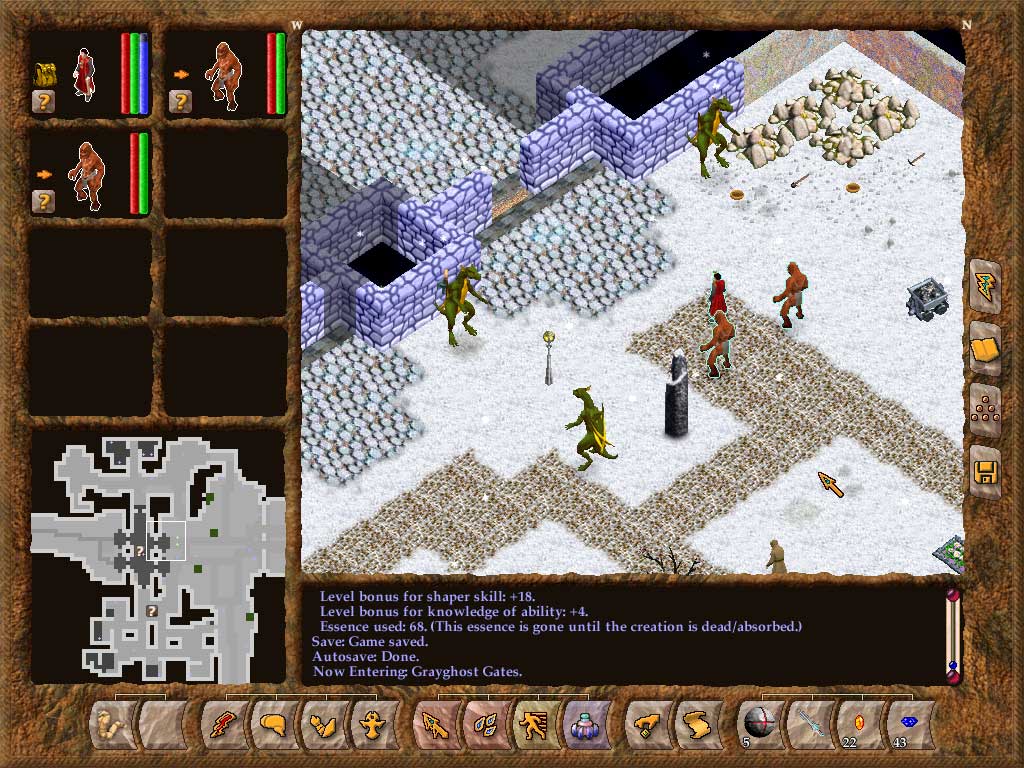
It's worthwhile at this point to go to the web site and look at the screenshots. Some of you might ask, "Why would anyone pay money for a game that looks like that?" The answer is, "I don't know, but they do."
I picked Geneforge 4 because it was very much an average performer for us. Some of our games have done worse. Some have done much better. Its sales were respectable, at about the minimum level I would require to consider its development a success. It's also worth pointing out that it did not get any distribution on third party sites, which is unusual for us these days. This made it easier to calculate sales for it, but also means that far fewer people played it than our other games.
Geneforge 4 was released for the Macintosh in November, 2006 (in time for Christmas) and PC Windows in February, 2007 (in time for there to be less competition). Unlike most of our games, it has never appeared for sale on another site (like RealArcade, MSN Games, etc.). All of the sales were directly from us. Geneforge 4 didn't get a lot of press, like most Indie games. Some web reviews, some news articles, a few banner ads, but news of it mainly spread by word of mouth.
How Much Did It Cost To Make It?
Spiderweb Software has three full-time employees, including me. I worked on Geneforge 4 full-time, doing coding and design. The other employees spent part of their time on the project, making graphics, helping with design details, and so on, so only part of their salaries counted toward Geneforge 4's budget. The game took about a year to make, including time for the Windows port, but it used a lot of code and graphics and sound assets from previous games.
Of course, while I am giving sales figures, I'm not going to reveal the salaries for everyone at Spiderweb Software. I will simply say that, between the salaries for the creators, the costs for freelancers to makes graphics, general business expenses for the year (insurance, internet, a new computer or two), and the printing costs for hint books, Geneforge 4 cost about $120K to make. If I had to do all of the code and graphics from scratch, this figure would have been around fifty percent higher.
Generally, when an Indie developer reveals the size of their budget, online commenters will go, "No way! It could never cost that much!" But time costs money. I work for a salary, and my time spent writing Geneforge 4 is time not spent earning money elsewhere. Salaries only don't count toward the budget if your time has no value. And time is the most valuable thing you have.
How Much Money Did It Make?
Of course, I can't say how much money Geneforge 4 is going to make overall. Its sales are pretty slow now, but it still sells. The game has always sold for $28. (That might seem very expensive for an Indie title. I will discuss the price at length in part two.) In addition, a hint book is available. The vast majority of copies of the hint book sell for $7. There are also some profits from CD sales, but it's only around a thousand bucks, so I left it out.
So let's look at the interesting numbers:
Total Copies Sold of Geneforge 4 as of March 13, 2009: 3979.
Total Gross Sales Geneforge 4 as of March 13, 2009: $111412.
Total Geneforge 4 Hint Books Sold as of March 13, 2009: 807.
Total Gross Sales Geneforge 4 Hint Books as of March 13, 2009: $5649.
Total Gross Sales Geneforge 4 as of March 13, 2009: $111412.
Total Geneforge 4 Hint Books Sold as of March 13, 2009: 807.
Total Gross Sales Geneforge 4 Hint Books as of March 13, 2009: $5649.
As you can see, we don't sell a huge number of copies ourselves. Our other titles, which are also available from other outlets, sell much higher raw numbers. (The original Geneforge, for example, has sold jillions of copies, though we got far less cash for most of those.) So does this mean that hardly anyone played Geneforge 4? No, for two reasons.
First, there is every reason to believe that for every copy that sells, a lot of pirated copies get played. I would bet folding money that tens of thousands of people (pirates, free riders, scum) have enjoyed Geneforge 4 for free. It's been cracked aplenty.
Second, Geneforge 4, like all of my games, has a large demo. Probably too large for my own good. The free portion of the game is almost a full, self-contained game. So there are a ton of people who got to play a big chunk of it, say, "OK, that was enough," and move on. And I can't blame them. They have done no wrong. I'm the one who set the size of the demo, after all.
But I think the most important thing to note is that Geneforge 4, after a few years, is almost in the black, and it continues to sell. In the long run, the time spent on it will be quite profitable. Despite the crude graphics. Despite the high price.
And I think there are some lessons to be learned here. Next week, I'll talk about how I set the price, break down the figures for Mac and Windows sales, and give aspiring developers some friendly advice.
Subscribe to:
Posts (Atom)